Beverages retail execution: why drinks are won with availability, coolers and rhythm
For beverages, retail execution is a combination of chilled availability, share of shelf, secondary placements, route frequency, promo timing and fast OOS response.
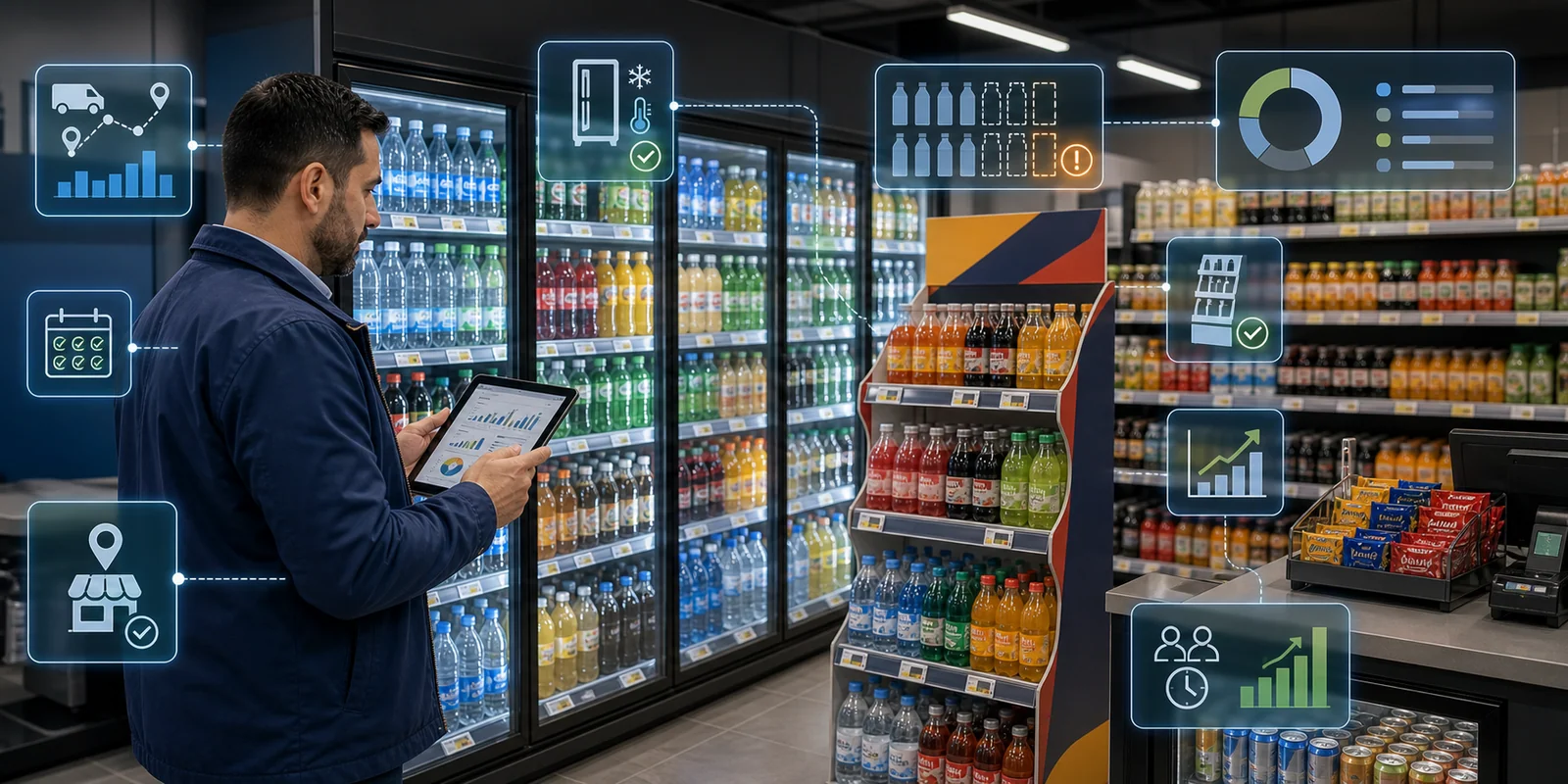
Beverages are one of the most dynamic FMCG categories.
Sales depend on availability, temperature, visibility, season, promotion, impulse and service frequency.
That is why beverages retail execution cannot be managed only with monthly sales.
It must be managed every day.
On the shelf. In the cooler. In the promotion zone. At checkout. On the route.
The category is fast, but not the same everywhere
It is a mistake to manage beverages with the same execution model across every channel.
In supermarkets, the goal may be strong category block, good share of shelf, correct price and promotional display. In convenience, the goal is often chilled availability and checkout impulse. In petrol, execution may depend on cooler fill, a small number of hero SKUs and frequent small replenishment. In HoReCa, the focus may be listing, menu presence, equipment, delivery reliability and outlet relationship.
Beverages execution should therefore follow channel playbooks:
- supermarket: planogram, share of shelf, promo display, price compliance;
- traditional trade: availability, minimum assortment, route rhythm, cash/order discipline;
- convenience: chilled availability, impulse placement, top SKUs;
- petrol: cooler fill, fast replenishment, high-margin impulse;
- HoReCa: listing, equipment, delivery reliability, agreed terms.
The same KPI can have different weight by channel. Cooler fill may be critical in convenience and petrol, while secondary placement may matter more in a supermarket promotion.
Chilled availability is critical
For many beverages, “product exists” is not enough.
The product needs to be available cold.
The shopper may not buy a drink if it is not in the cooler or if the cooler is empty. This is especially true in convenience, petrol, HoReCa and impulse channels.
Cold equipment should be managed as a sales asset:
- correct location;
- working cooler;
- temperature;
- fill level;
- hero SKU;
- competitor intrusion;
- maintenance issues;
- sales uplift.
The cooler is not just equipment. It is part of availability.
OOS is more expensive than it looks
Out-of-stock in beverages often creates immediate loss.
The shopper rarely waits.
If the preferred drink is missing, they may:
- buy a competitor;
- choose another size;
- buy another category;
- buy nothing;
- miss the promotion.
That is why AI Order Brain should use execution signals: historical sales, seasonality, promotion, chilled stock, shelf image, delivery frequency and OOS risk.
Share of shelf and share of cooler
In beverages, visibility is highly competitive.
The team should not measure only share of shelf.
It should also measure share of cooler.
Key questions:
- how many facings does the brand have;
- where are hero SKUs;
- is the brand block intact;
- is a competitor taking agreed space;
- are top shelf or eye-level positions executed;
- are there empty gaps;
- does the chilled zone follow category logic.
Share of shelf and Image recognition can turn the photo into a measurable shelf signal.
Route frequency should be more dynamic
Beverages are influenced by:
- seasonality;
- temperature;
- weekends;
- local events;
- holidays;
- promotions;
- tourist flow;
- cooler availability;
- delivery cycle.
That is why Visit frequency should not be static for every customer.
A store with high impulse potential and frequent OOS risk may need more frequent visits. Another store with low turnover may be served less often or through a different channel.
Promotions must be operationally ready
In beverages, a promotion may fail if:
- product is not delivered on time;
- the cooler is not filled;
- promo price is missing;
- secondary placement is not installed;
- POSM is missing;
- store staff moved the display;
- OOS happens in the first days.
Trade promotion execution and Promo compliance should be monitored in-flight, not only after the campaign ends.
The sales rep needs next-best-action
If beverage execution is reduced to a checklist, the team will report activity but not necessarily close problems.
A better logic is next-best-action:
- if hero SKU is missing: suggest an order or check backroom stock;
- if cooler fill is falling: create a replenishment task;
- if a competitor occupies agreed space: escalate to supervisor or key account;
- if promotion starts tomorrow: check stock and display readiness;
- if the customer has high OOS risk: increase visit priority;
- if route capacity is limited: choose higher-potential outlets.
AI agents can help here by monitoring execution signals and suggesting actions, while still keeping human control in the process.
Secondary placements and checkout impulse
Beverages often win from additional points:
- checkout cooler;
- promo island;
- endcap;
- entrance display;
- seasonal display;
- HoReCa visibility;
- petrol station impulse zone.
Secondary placements should be measured as compliance and ROI, not only as “display exists”.
The right location can matter more than the discount itself.
KPIs for beverages retail execution
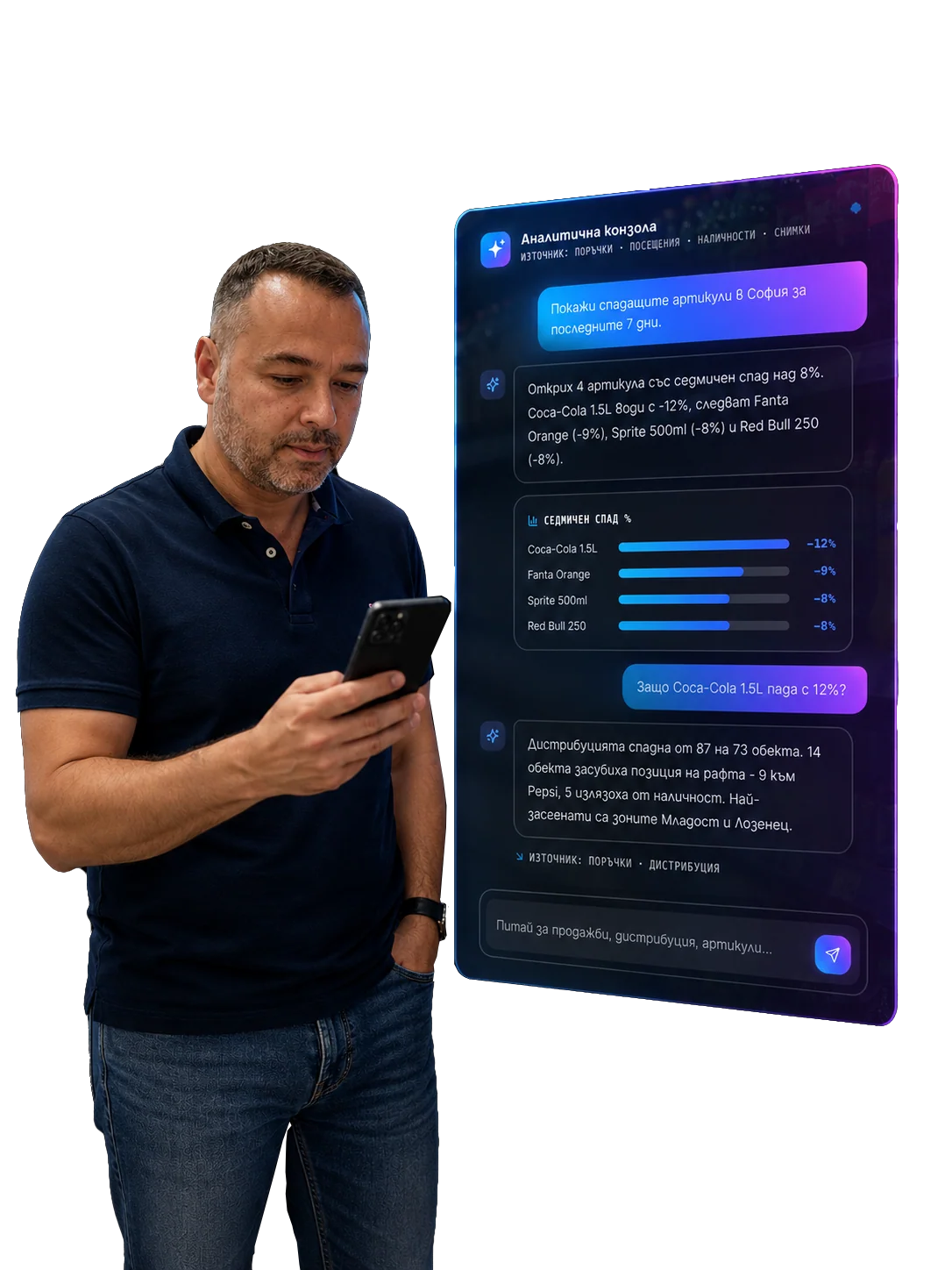
A good beverages dashboard should show:
| KPI | Why it matters |
|---|---|
| Chilled availability | whether product is ready to buy |
| Cooler fill level | whether the cooler sells |
| OOS by SKU | where sales are lost |
| Share of shelf/cooler | competitive visibility |
| Promo execution | whether campaign is executed |
| Secondary placement compliance | whether additional visibility exists |
| Visit frequency | whether service rhythm is right |
| Recommended order acceptance | whether the team trusts order logic |
| Route productivity | whether service is efficient |
These KPIs should be analyzed by channel: supermarket, traditional trade, convenience, petrol, HoReCa.
What a good beverages operating rhythm looks like
A good system does not wait for month end.
It works in a short cycle:
- Before the route: AI evaluates OOS risk, promotion calendar, route priority and recommended order.
- During the visit: the rep checks shelf, cooler, price, promo display and stock.
- After the photo: image recognition returns SKU, facings, gaps, fill and confidence.
- After a deviation: workflow creates an action with an owner.
- After delivery: DMS confirms fill rate and secondary sales.
- After the period: BI compares execution, sell-out, route cost and promo uplift.
This cycle matters more than the dashboard itself. A dashboard without action only shows that the sale was missed. Operating rhythm reduces the chance that it will be missed.
In short
Beverages retail execution is won with rhythm and availability.
The critical elements are:
- chilled availability;
- cooler execution;
- OOS prevention;
- share of shelf and cooler;
- route frequency;
- secondary placements;
- promo timing;
- recommended order;
- fast issue closure.
In beverages, late reaction often means missed sale.
Related in Optimasoft
- Cold equipment shows how to manage coolers as sales assets.
- Image recognition measures shelf, cooler, facings and gaps.
- AI Order Brain supports OOS prevention and recommended orders.
- Route optimization optimizes visits and deliveries based on potential and risk.
- Promo compliance checks whether campaigns are physically executed.
- OptimaDMS connects stock, delivery and distributor execution.
Sources
Related articles