Shelf image quality: why a bad photo creates a bad AI signal
Computer vision is only as good as the input signal. If the shelf photo is blurred, dark, cropped, angled or missing clear boundaries, AI will return a weaker and less reliable result.
Shelf computer vision is often discussed through the model.
Which detection engine is used. How many SKUs it can recognize. What accuracy it reaches. How quickly it returns a result.
These questions matter, but they are not the first reason a system works or fails.
The first reason is the image.
If the photo is poor, AI does not start with a slightly harder task. It starts with a weak signal. A blurred image, bad angle, cropped section, cooler reflection or missing bottom shelf can turn a capable model into an uncertain analysis.
That is why shelf image quality is not a technical detail. It is part of the retail execution process.
A bad photo is not just a bad photo
In FMCG, a shelf photo is not a gallery asset.
It is an input for measurement:
- is the product available;
- how many facings does it have;
- is it in the right position;
- is there an empty space;
- is the planogram executed;
- is the price visible;
- is promo material present;
- what action should be created.
If the input is weak, every layer after it suffers. Image recognition may return lower confidence, send the image to human review, miss a small SKU, fail to match a price label to a product or count facings incorrectly.
The issue is not only model accuracy. It is process trust.
If a sales rep captures a weak image and the system returns a disputed result, the team can easily conclude that “AI does not work”. In reality, the capture process was often not controlled well enough.
What makes a good shelf image
A good shelf image does not need to be beautiful.
It needs to be measurable.
1. The full relevant shelf is visible
The system must see the complete area it is expected to analyze. If the bottom shelf is cropped, the category boundary is missing or only half of the block is captured, the result will be incomplete.
This is critical for Planogram compliance, because the realogram is compared with an agreed standard. If the real shelf is only partially captured, the comparison becomes questionable.
2. The angle does not distort the shelf
A strong side angle can hide products, change the visible size of facings and confuse shelf boundaries.
The sales rep cannot always stand perfectly in front of the shelf. Stores are narrow, customers pass by, carts are in the aisle, cooler doors create physical constraints. But the system should guide the user: step slightly back, move more centrally, reduce the angle.
3. There is no motion blur
Motion blur is one of the most underestimated problems.
For a human, the photo may look “good enough”. For computer vision, small blur can erase the difference between two similar SKU variants, make a barcode or shelf label unreadable and lower confidence.
Capture UX should detect blur before the image is accepted.
4. Lighting is reasonably even
Dark aisles, strong lamps, cooler reflections and glossy packaging create noise.
In beverages, dairy, personal care and refrigerated categories, reflection can hide a label, price or product line. This affects Share of shelf, SKU recognition and price compliance.
5. There is no occlusion
A hand, customer, cart, open cooler door, shelf strip covering the label or one product blocking another can all create occlusion.
AI cannot reliably recognize what is not visible.
This sounds obvious, but it matters for operational governance: if the issue is occlusion, the action should not be “SKU missing”. It should be “retake photo” or “manual review”.
6. Resolution is sufficient for SKU-level recognition
Recognizing a category is not the same as recognizing a SKU.
In FMCG, the system often has to distinguish flavor, size, promo variant, new packaging, multipack or local-language pack. That requires enough detail in the image.
That is why a generic “take a shelf photo” instruction is not enough. Large categories may require multiple photos, panorama capture or a clear rule for splitting the shelf.
Capture guidance is part of the product
A good system does not leave the sales rep guessing whether the image is usable.
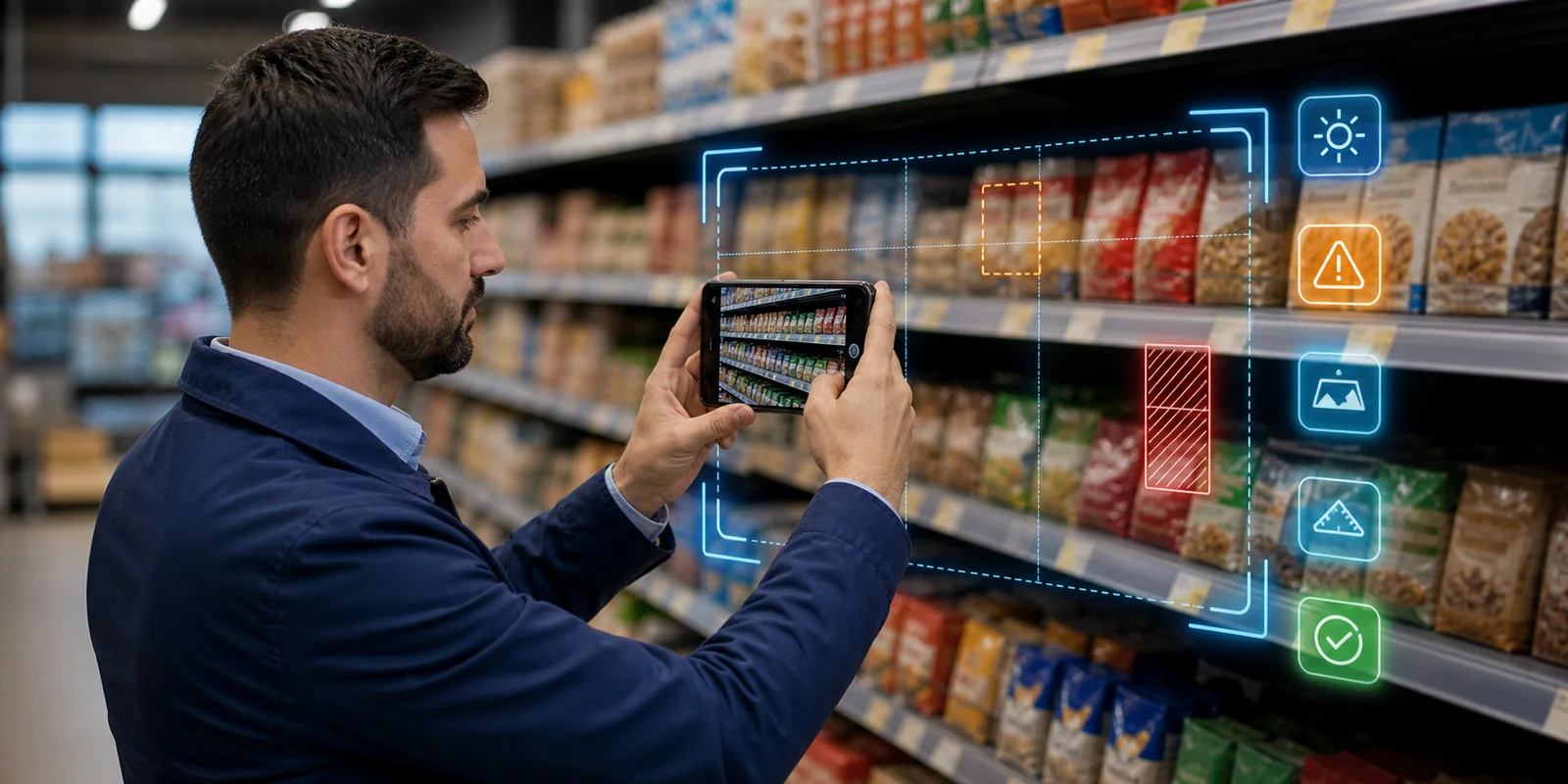
It should guide the capture moment:
- frame for the full shelf;
- blur warning;
- lighting check;
- strong angle signal;
- shelf boundary visibility;
- missing zone hint;
- automatic retake recommendation;
- confidence after analysis.
This is not optional UX polish. It is quality control.
If capture guidance is missing, the company pushes the problem downstream to the rep, supervisor and AI team. Every later dispute becomes more expensive.
Confidence is not a weakness, it is control
The worst AI result is not an uncertain one.
The worst result is a wrong one presented as certain.
Every shelf image system should work with confidence:
- high confidence: an action can be created automatically;
- medium confidence: the result is shown with a warning;
- low confidence: the photo goes to retake or human review;
- conflicting signal: the system should not automatically penalize the rep.
This is especially important for Promo compliance and Price compliance. If AI reads a price incorrectly or misses a promo label, it can create a false issue for the team.
A good system knows when it does not know.
A poor image changes the business decision
Shelf image quality directly affects:
- on-shelf availability;
- facing count;
- share of shelf;
- planogram compliance;
- promo execution;
- price compliance;
- recommended order;
- supervisor coaching;
- store scorecard.
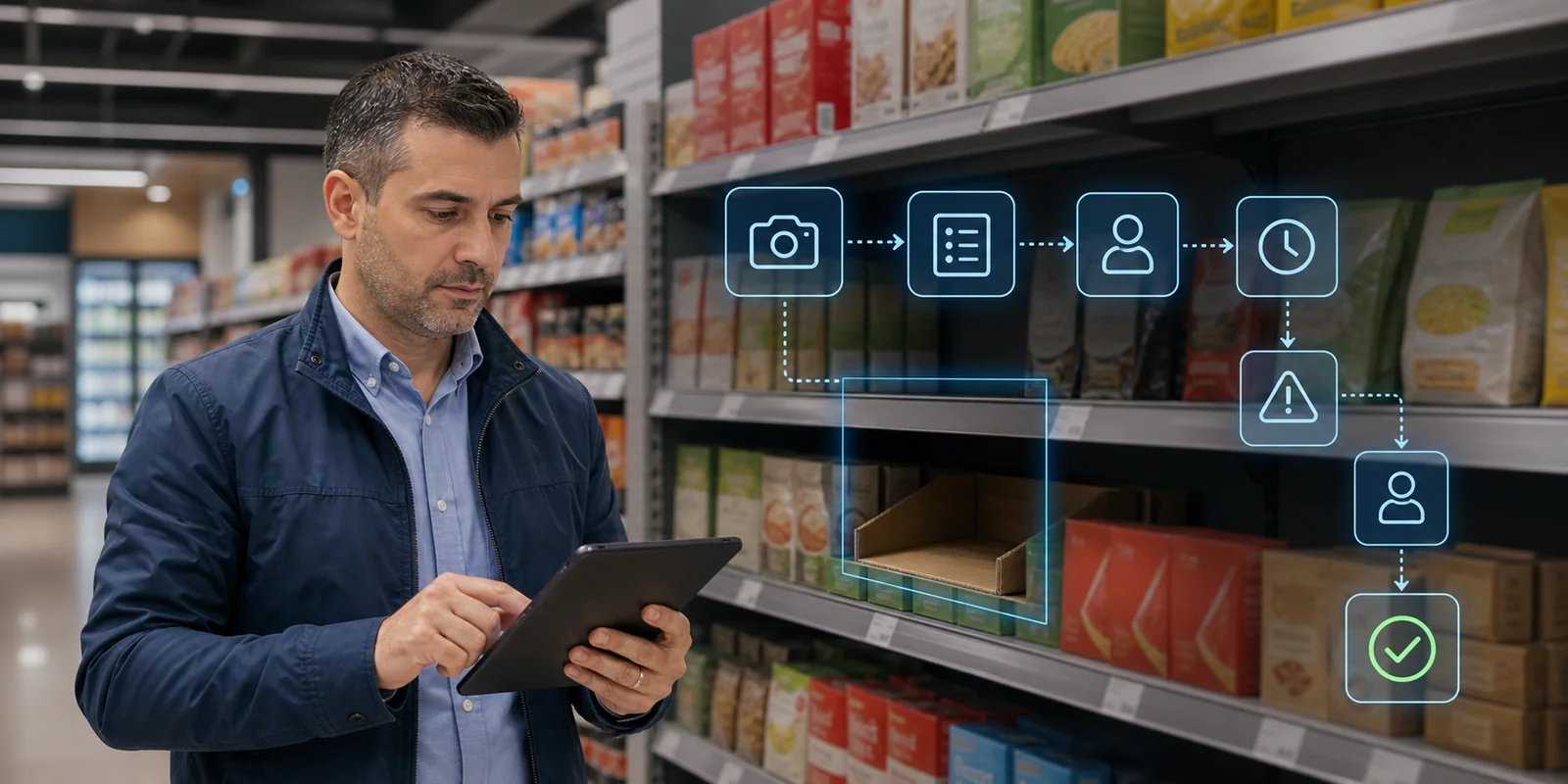
If the image does not show the real shelf, AI Order Brain may receive a wrong signal about missing stock or weak facings. If an issue is created from an uncertain image, Workflow orchestration will move the wrong task through the organization. If a supervisor dashboard reports weak compliance without capture quality control, coaching can become unfair.
This is why image quality should be treated as a business KPI, not only as a technical filter.
What should be measured
An FMCG platform should track image quality metrics:
| Metric | Why it matters |
|---|---|
| Accepted vs rejected photos | shows whether the capture process is clear |
| Retake rate | reveals category, store or team-level capture issues |
| Blur rate | affects SKU recognition and OCR |
| Angle and position warnings | affects facings and shelf boundaries |
| Low-confidence analyses | shows where AI needs review |
| Manual review rate | reveals operational cost |
| Disputed AI results | shows the trust gap |
These metrics help the team understand whether the issue is in the model, the capture process, the category or data governance.
In short
Shelf image quality is the first layer of shelf intelligence.
If the image is good, AI can turn the shelf into a reliable business signal. If the image is poor, even a strong model will return uncertain, incomplete or disputed results.
The right approach is:
- capture guidance inside the mobile app;
- automatic checks for blur, angle, lighting and boundaries;
- confidence attached to each result;
- retake instead of false certainty;
- human review for low-confidence cases;
- action loop only when the signal is reliable enough.
The photo is not a formality.
It is the start of the entire retail execution logic.
Related in Optimasoft
- Image recognition turns shelf images into structured signals for SKU, facings, OSA, price and promotion.
- Computer vision for shelf explains the full pipeline from image to realogram.
- Planogram compliance depends on clear shelf boundaries and complete image capture.
- Share of shelf requires reliable facing counts.
- Workflow orchestration should create actions only when the signal is reliable enough.
- AI governance in FMCG puts confidence, review and ownership into a manageable process.
Sources
- Real-time retail planogram compliance application using computer vision and virtual shelves - PMC
- A comprehensive survey on computer vision based approaches for automatic identification of products in retail store - Image and Vision Computing
- Computer Vision Based Planogram Compliance Evaluation - Applied Sciences
- U-PC: Unsupervised Planogram Compliance - CVF/ECCV
Related articles