Planogram compliance in FMCG: why the planogram is not a PDF, but a measurable standard
A planogram has value only if the real shelf can be compared to it objectively. The real question is not whether we have a planogram, but whether the store physically executes it.
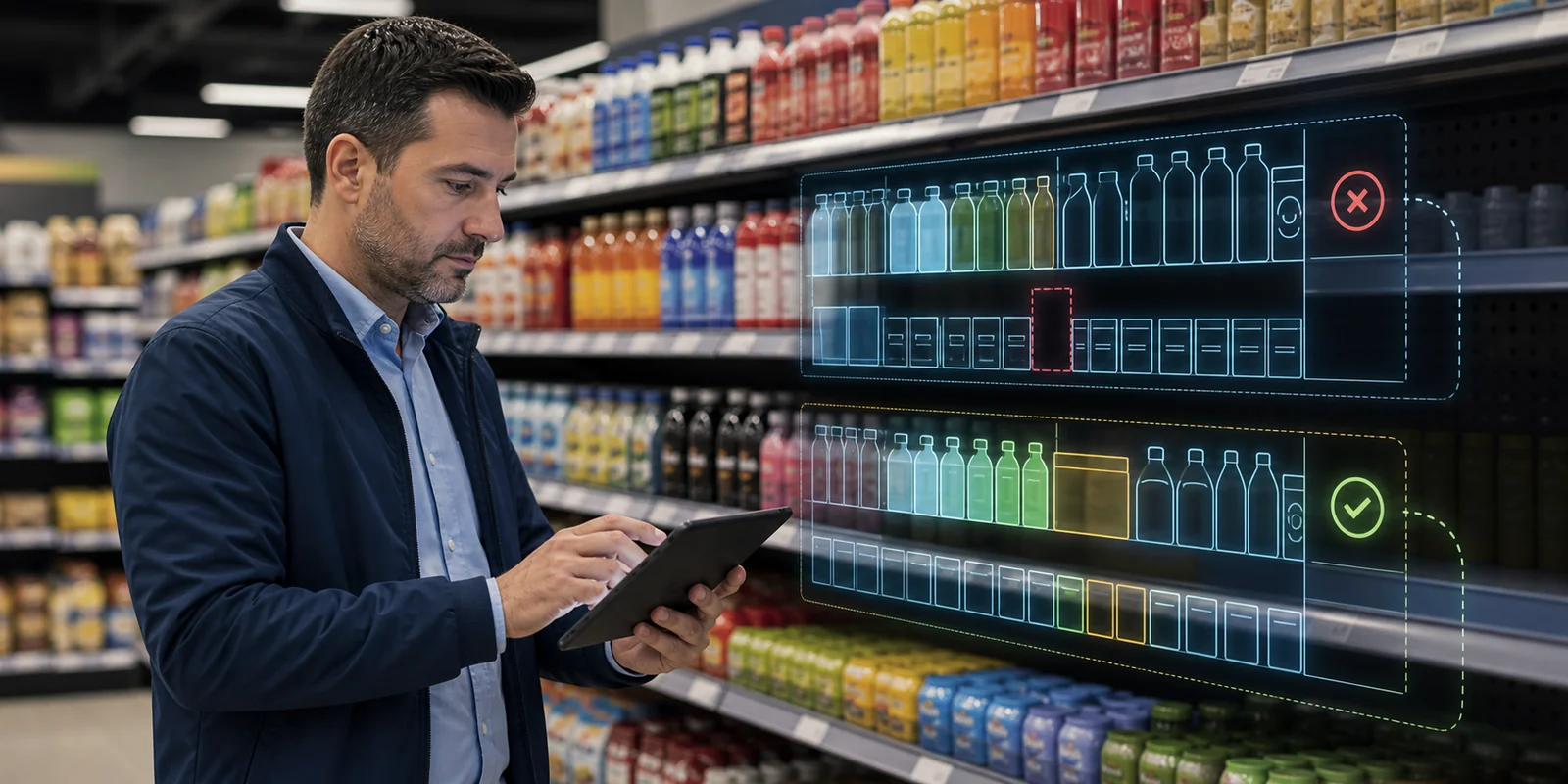
The planogram often starts as a document.
PDF. Scheme. Category recommendation. Agreed standard. Internal presentation.
But inside the store, it is either physically executed or it is not.
That is why planogram compliance should not be treated as "do we have a planogram". It should be treated as:
Does the real shelf match the standard we agreed and expect to move sales?
That is a different question.
Planogram vs realogram
The planogram is the planned shelf.
The realogram is the real shelf.
Planogram compliance is the comparison between the two.
If this comparison is manual, the result is often slow, subjective and hard to scale. One representative may judge the gap one way. Another may judge it differently. The manager sees a photo, but not always a measurable gap.
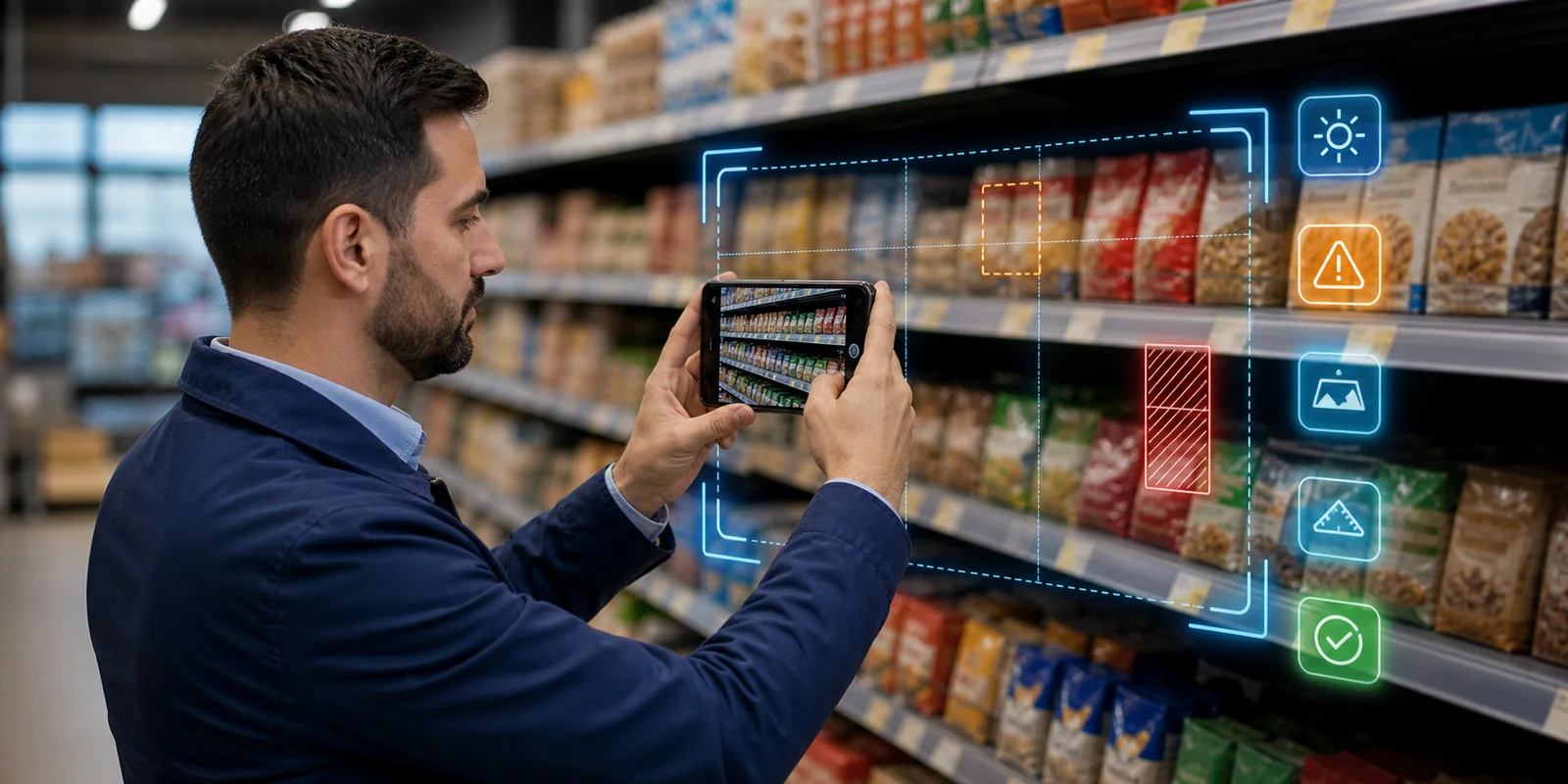
Image recognition changes this because the photo can become a structured shelf signal:
- which products are present;
- where they are positioned;
- how many facings they have;
- whether they are in the right block;
- whether empty spaces exist;
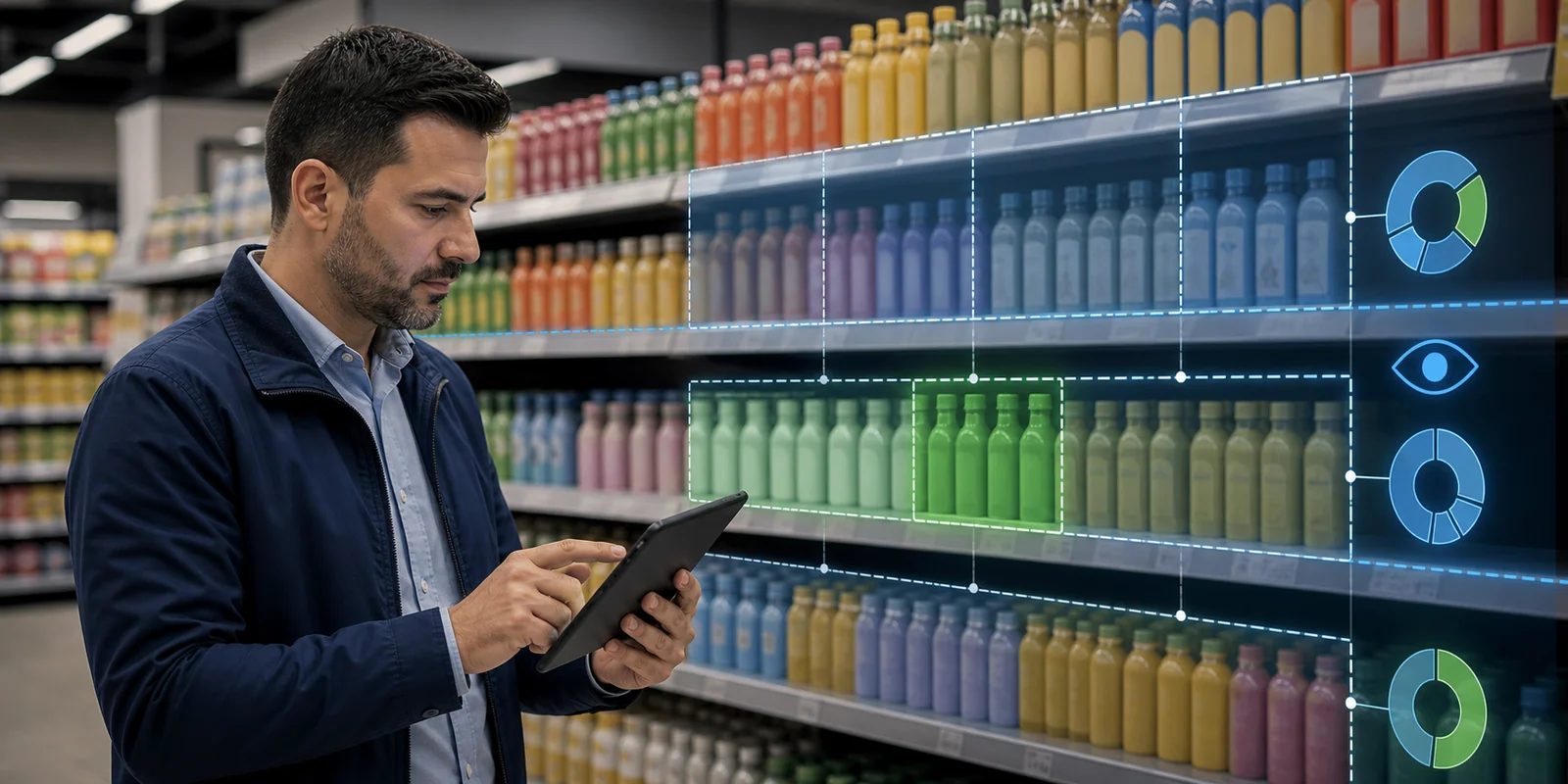
- whether share of shelf is below standard;
- whether promo SKU is in the right zone.
What should be measured
Planogram compliance is not one percentage.
It should be split into measurable components.
1. Product presence
Is the right product present on the shelf?
This is the base. If a must-stock SKU is missing, the rest of compliance loses value.
2. Position
Is the product in the right place?
Position matters: eye-level, brand block, category zone, cooler, secondary placement.
3. Facings
Does the product have the agreed number of facings?
One facing and four facings are not the same visibility.
4. Block integrity
Does the brand hold a block, or is it scattered between competitors?
5. Gap severity
Not every deviation is critical.
Missing hero SKU is more serious than two slow-moving products swapped.
6. Action status
Did the deviation create action?
Without action, planogram compliance remains audit.
Compliance score with weights
It is a mistake for all deviations to weigh the same.
A better score looks at severity:
| Gap | Weight | Reason |
|---|---|---|
| Missing hero SKU | high | direct missed-sales risk |
| Low share of shelf | high/medium | competitive pressure |
| Wrong position | medium | visibility drops |
| Missing minor SKU | low/medium | depends on category |
| Light block gap | low | may not need urgent action |
Perfect Store scorecard should use the same logic: weighted standard, not flat checklist.
One standard is not enough for every channel
A common mistake is to manage planogram compliance as a universal standard.
Modern trade, traditional trade, convenience, HoReCa, petrol stations and cash & carry do not work in the same way. Shelf size, SKU count, available space, shopper behavior and ability to intervene are different.
A good FMCG platform should support standards:
- by channel;
- by store format;
- by category;
- by customer segment;
- by season;
- by promotion period;
- by strategic outlet priority.
Otherwise the score becomes unfair. A small neighborhood store can be penalized for something it physically cannot execute. A large key account can look good on average while losing a critical position for a hero SKU.
Planogram compliance should be strict, but contextual.
Root cause: shelf problem is not always a shelf problem
When a planogram gap appears, the first instinct is to say "the sales rep did not fix it".
Sometimes that is true.
But the reason may be different:
- the product was not delivered;
- the minimum order is too high;
- the store has no space;
- a competitor has aggressive promotion;
- the planogram standard is unrealistic;
- the SKU is locally delisted;
- shelf label is missing;
- store staff moved the product;
- route frequency is not enough.
That is why planogram compliance should connect with OptimaDMS, order history, route execution and promotion calendar. If the shelf is empty but the warehouse did not deliver the product, a task for the representative will not solve the problem.
This is why planogram should be treated not as an image recognition KPI, but as an execution loop.
What happens after the deviation
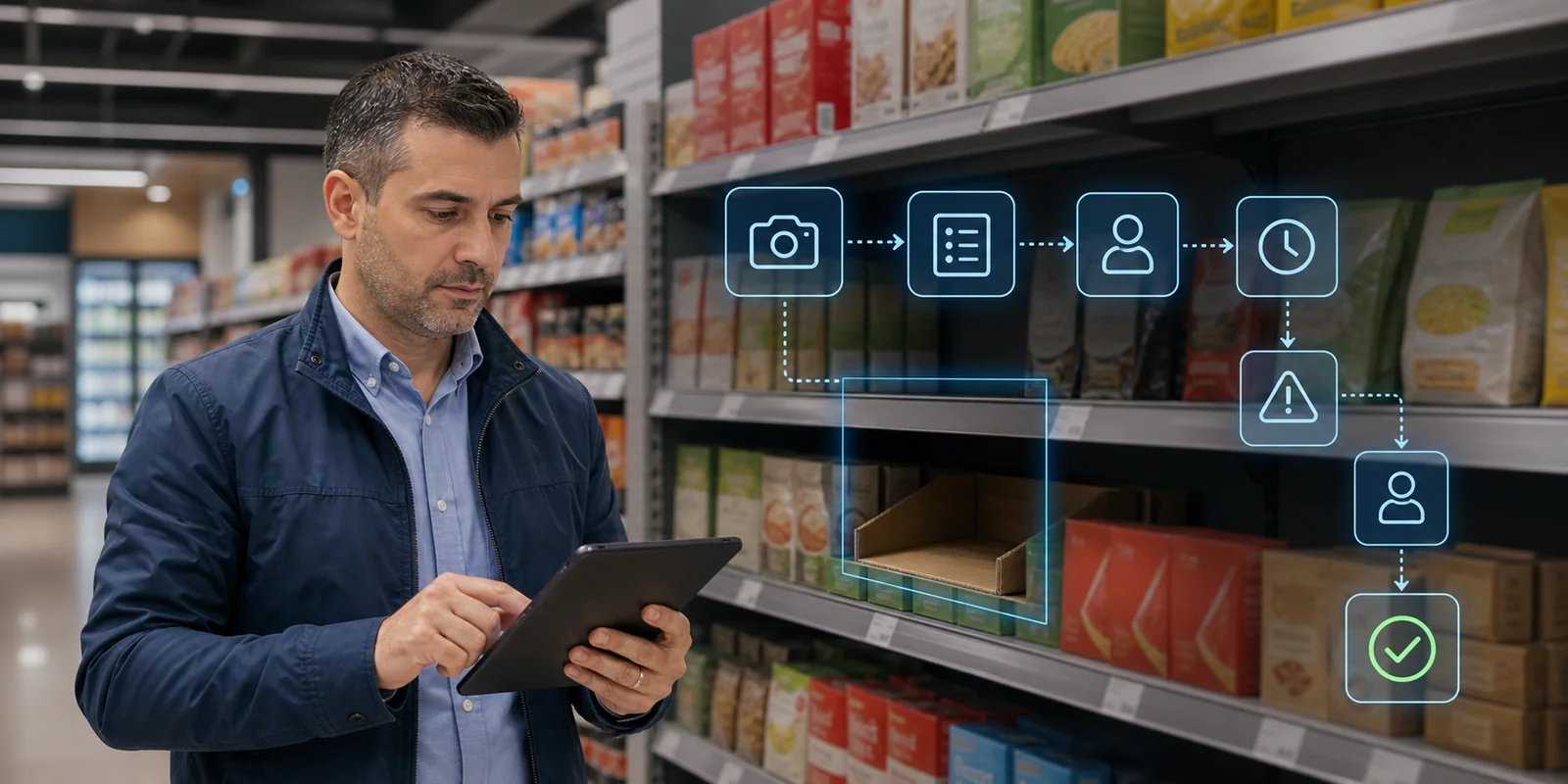
Detecting a deviation is only the first step.
Then the system needs to decide:
- can the representative fix it immediately;
- should an issue be created;
- should the order change;
- should supervisor intervene;
- is the problem recurring;
- is there a supply reason;
- what evidence closes the issue.
Workflow orchestration is critical here. Planogram compliance without action loop is just reporting.
When AI helps and when review is needed
Computer vision is powerful, but it should not be used as a black box.
In planogram compliance there are cases where the model can be highly confident: clear product, good photo, right angle, visible label and limited overlap.
There are also cases where human review is needed:
- poor lighting;
- partly hidden SKUs;
- new packaging;
- very similar products;
- cooler reflections;
- low resolution;
- crowded shelf.
The practical standard is confidence-based workflow. High confidence can create an issue directly. Medium confidence can go to supervisor review. Low confidence should request a better photo or manual check.
That keeps the system useful without creating false precision.
What not to do
Measure everything equally
That creates a falsely precise score.
Treat the planogram as universal
Different channels and categories have different standards.
Look only at photos
The photo is evidence. The business signal is the measurement.
Have no owner
If a gap has no owner, it will repeat.
In short
Planogram compliance in FMCG is not a PDF check.
It is a measurable shelf standard:
- planogram;
- realogram;
- product presence;
- position;
- facings;
- block integrity;
- gap severity;
- action closure.
The value is not simply knowing the shelf is different.
The value is knowing which deviation matters and what action will fix it.
Related in Optimasoft
- Image recognition turns shelf image into measurable realogram.
- Shelf computer vision explains the technical layer behind recognition.
- Perfect Store scorecard shows how planogram compliance enters a weighted store standard.
- Workflow orchestration closes the deviation as action, owner and closure.
- Retail Execution KPI places planogram compliance in the broader KPI model.
Sources
- Computer Vision Based Planogram Compliance Evaluation - Applied Sciences
- Real-time retail planogram compliance application using computer vision and virtual shelves - PubMed
- A comprehensive survey on computer vision based approaches for automatic identification of products in retail store - Image and Vision Computing
- Bain & Company - Perfect Store: How advanced analytics is transforming sales execution
- NielsenIQ - Total Distribution Points and CPG brands
Related articles