Recommended order acceptance rate: the KPI that shows whether AI helps the sales rep
Acceptance rate is not just the percentage of AI orders accepted. It reveals trust, recommendation quality, data gaps and where the human knows something the model does not yet know.
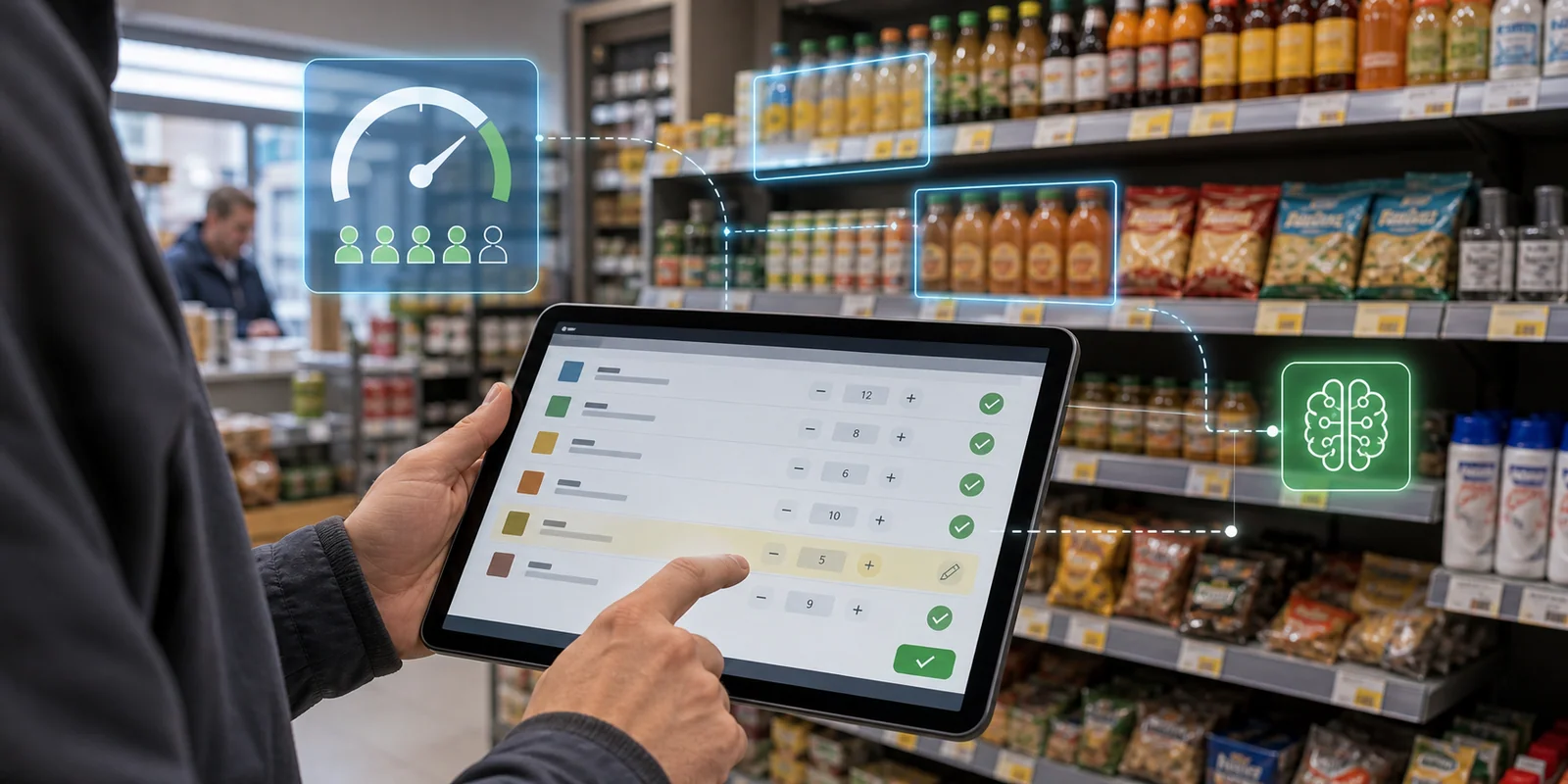
A recommended order only matters if the sales rep uses it.
But “uses it” does not mean accepting it exactly as proposed every time.
This is where recommended order acceptance rate becomes important. It shows what share of AI recommendations are accepted without change, what share are adjusted and what share are rejected.
At first glance, this is an adoption metric.
In reality, it is much more.
This KPI shows whether AI Order Brain provides useful recommendations, whether sales reps trust it, whether the data is good enough and where business context is missing from the model.
Acceptance rate should not be 100%
It is a mistake to assume that the perfect target is 100% acceptance.
If the sales rep always accepts the recommendation, several things may be true:
- the model is genuinely strong;
- the sales rep has no incentive to think;
- the UX makes adjustment difficult;
- the KPI system penalizes changes;
- recommendations are too conservative;
- real exceptions are not being captured.
In FMCG, there are many situations where the human has valid context the model does not yet see.
For example:
- the customer said the store will be closed next week;
- product is in the backroom but not replenished;
- the owner refuses a specific SKU;
- the promotion starts later in reality;
- delivery was delayed;
- the cooler is broken;
- new packaging confuses image recognition;
- a local competitor launched an aggressive offer.
The goal is not “AI is always right”.
The goal is for the recommendation to be good enough to reduce manual work, but flexible enough to allow human correction.
What exactly should be measured
Recommended order acceptance rate should be split into several metrics.
| KPI | What it shows |
|---|---|
| Full acceptance rate | the order was accepted without change |
| Line acceptance rate | which SKU lines were accepted |
| Quantity adjustment rate | how often quantities are changed |
| Rejection rate | which recommendations are rejected |
| Manual add rate | which SKUs are added manually |
| Manual remove rate | which SKUs are removed |
| Reason code coverage | whether the adjustment has a reason |
| Post-order performance | whether accepted or adjusted orders improved outcomes |
Full acceptance rate alone is not enough.
If 80% of orders are “accepted”, but key SKU lines are constantly adjusted, the model has a problem. If sales reps manually add the same product across many stores, master data, assortment or demand signals may be missing.
Adjustment is a valuable signal
A sales rep adjustment should not be treated as disobedience.
It is a training signal.
When the rep changes a recommended order, the system should ask why:
- customer request;
- stock in backroom;
- temporary closure;
- delivery constraint;
- promo timing;
- price issue;
- assortment exception;
- product unavailable;
- competitor action;
- sales rep judgement.
These reason codes make the adjustments usable.
Without them, we only see that “AI was changed”. With them, we understand whether the issue is in the model, the data, supply chain, the customer or the execution process.
Acceptance rate by segment, not only average
Average acceptance rate can hide the truth.
It should be analyzed by:
- channel;
- store segment;
- route;
- sales rep;
- distributor;
- category;
- SKU;
- promotion period;
- region;
- customer type;
- season.
For example, acceptance rate may be higher in modern trade because orders are more structured. In traditional trade, there may be more adjustments due to local relationships, cash constraints, backroom stock or specific agreements.
This is why Outlet segmentation matters. One recommended order logic cannot work the same way for a kiosk, minimarket, HoReCa customer and large supermarket.
How AI should explain the recommendation
Sales reps accept recommendations more easily when they understand why they were made.
The recommendation should show factors such as:
- recent sales;
- historical order;
- minimum stock;
- seasonality;
- promotion;
- out-of-stock risk;
- shelf image signal;
- planogram gap;
- store potential;
- delivery frequency.
This should not be a huge analytics screen. In a mobile workflow it should be short: “+2 because promo starts”, “risk of OOS”, “low shelf stock”, “usual order”.
AI does not replace the rep. It gives the rep an argument.
What to do with low acceptance rate
Low acceptance rate does not automatically mean that sales reps are resisting the system.
Possible causes differ:
- weak forecast logic;
- missing sales data;
- wrong assortment;
- outdated product master;
- weak shelf image signal;
- outdated planogram;
- promotions not loaded in the system;
- UI that does not explain the reason;
- lack of trust;
- wrong KPI pressure.
Before blaming the team, the process should be diagnosed.
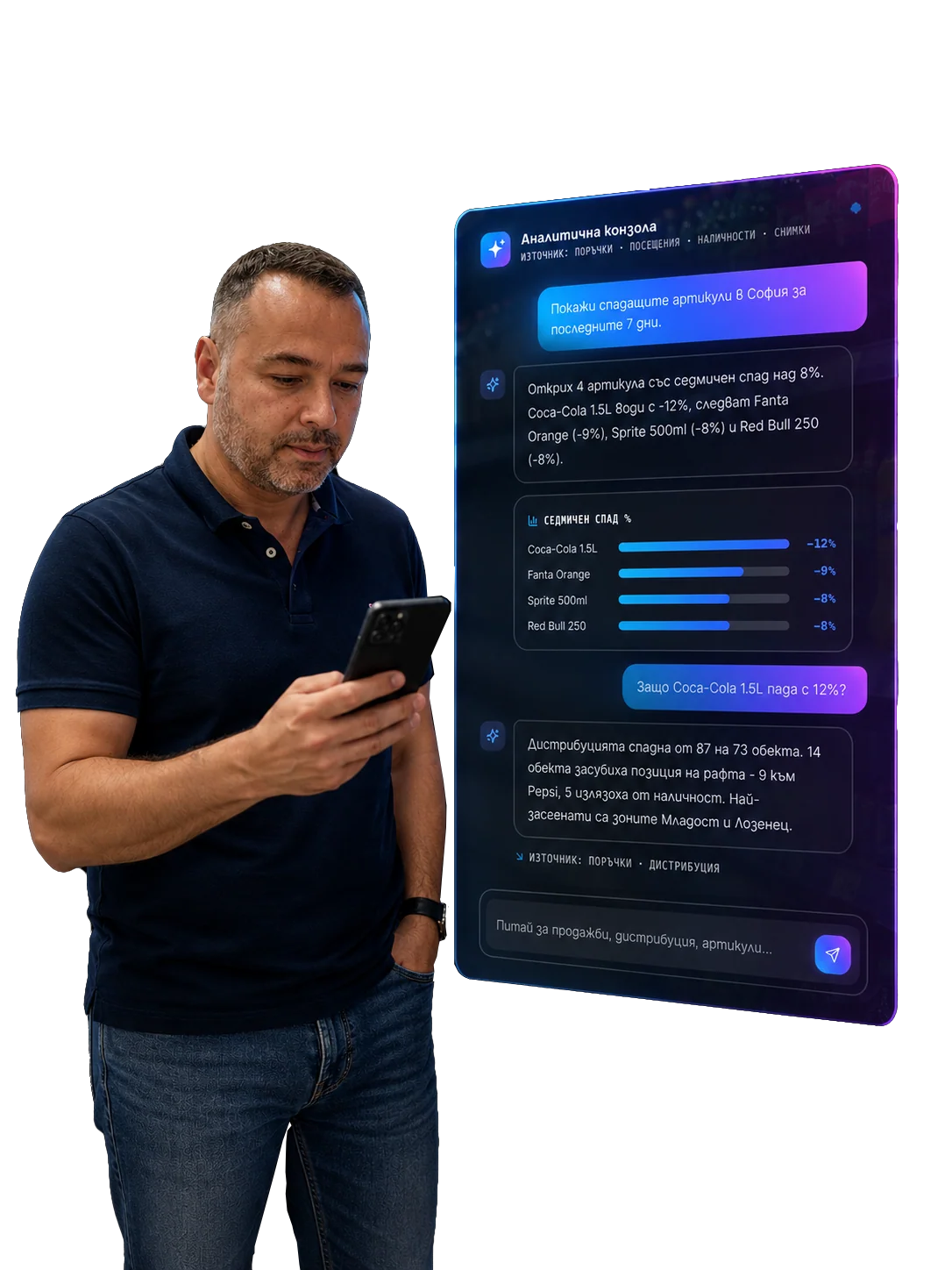
Chat BI can help when a manager asks: “Which SKUs are adjusted most often in the North region?” or “Which routes reject AI recommendations the most?”
What to do with high acceptance rate
High acceptance rate is not automatically a good sign either.
The team should check:
- is real sell-out improving;
- is out-of-stock decreasing;
- is overstock decreasing;
- is fill rate improving;
- is manual work reduced;
- are reps accepting wrong recommendations for convenience;
- is there pressure not to adjust.
If acceptance is high but sales do not improve, the KPI is a vanity metric.
The real question is whether the recommendation leads to better availability, better turnover and fewer errors.
The link with execution data
A good recommended order does not come only from sales history.
It should use execution signals:
- Realogram vs planogram;
- Share of shelf;
- Promo compliance;
- Price compliance;
- visit history;
- delivery frequency;
- store potential;
- seasonal demand.
If the shelf is empty but sales are low, the model needs to understand whether this is weak demand or missed sales due to lack of availability. If promotion is not executed, order recommendation should not blindly expect promo uplift.
This is why AI order taking must be connected with retail execution, not treated as a separate module.
In short
Recommended order acceptance rate is one of the most important KPIs for AI order taking in FMCG.
But it must be used correctly.
We are not chasing 100% acceptance.
We are chasing a better recommendation, less manual work, better availability and a better business result.
The right approach is:
- full and line-level acceptance;
- reason codes for adjustments;
- analysis by channel, SKU, route and sales rep;
- comparison with post-order performance;
- human-in-the-loop control;
- continuous learning from real adjustments;
- integration with shelf, promo, price and route data.
An AI recommendation is good when the sales rep accepts it often, adjusts it meaningfully and the system learns from every correction.
Related in Optimasoft
- AI Order Brain creates recommended orders from sales, stock, execution and context.
- AI order taking in FMCG explains why a recommended order is more important than an automated order.
- OptimaSale manages the field sales process, visits and order workflow.
- Chat BI helps managers analyze acceptance rate and adjustments.
- Human-in-the-loop AI shows why human correction is control, not weakness.
Sources
Related articles