EU AI Act for FMCG AI solutions: what business teams need to know in 2026
The AI Act does not stop AI in FMCG, but it requires transparency, governance, documentation and human control. The key is knowing which AI component carries which risk and what evidence the vendor can provide.
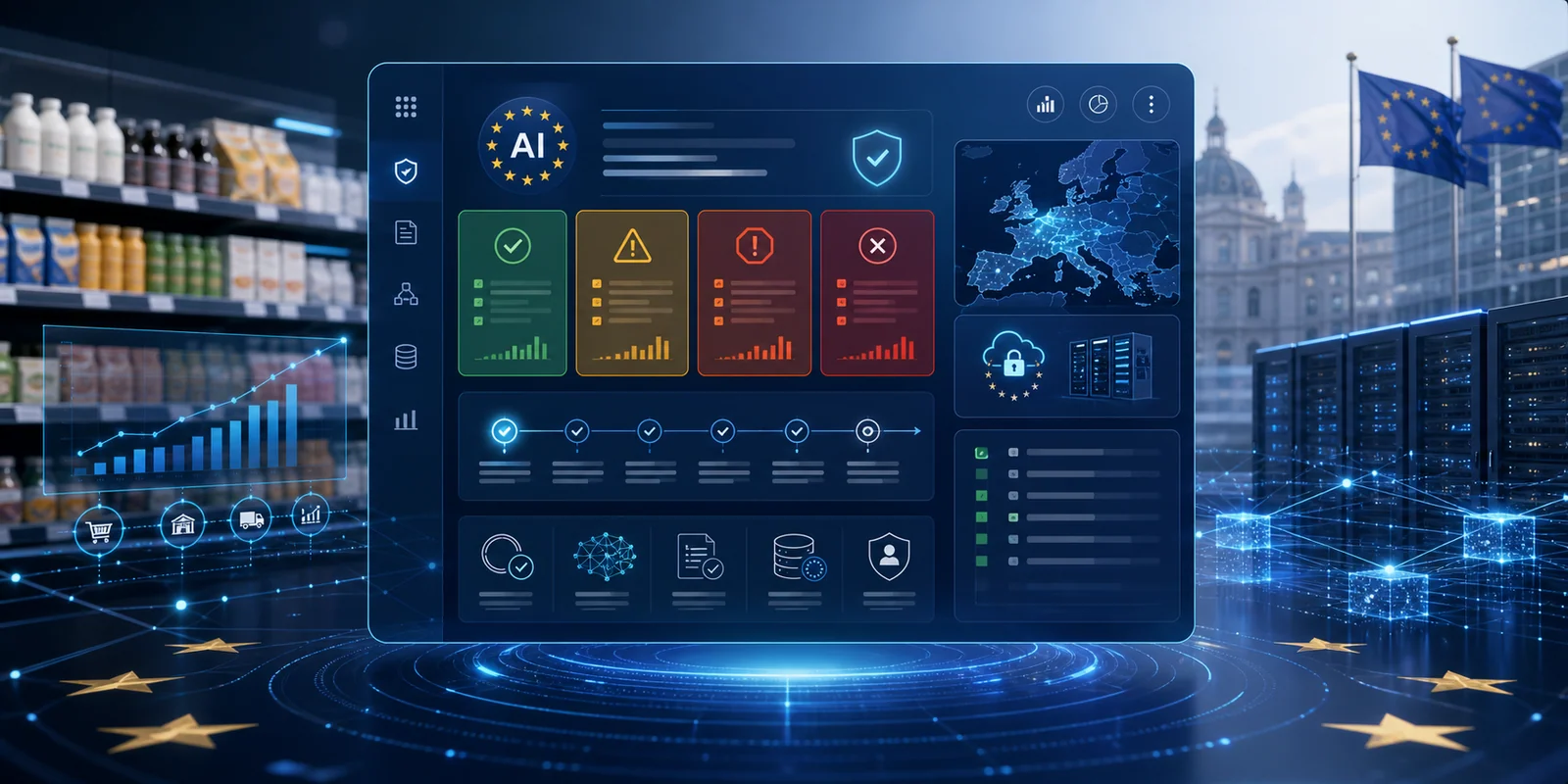
The EU AI Act does not mean FMCG companies must stop using AI.
It means AI must now be managed.
For companies using AI for shelf recognition, recommended orders, route optimization, Chat BI, sales coaching or AI agents, this is a practical topic. It is not only a legal document.
The question is no longer “do we have AI”.
The question is:
Do we know what AI we use, what risk it carries, how the decision is explained and who is accountable if the system is wrong?
The timeline in 2026
Regulation (EU) 2024/1689 entered into force on 1 August 2024 and applies in stages.
As of 4 June 2026, the practical picture is:
- 2 February 2025: prohibited AI practices and AI literacy requirements.
- 2 August 2025: GPAI rules, governance and penalties.
- 2 August 2026: important Article 50 transparency obligations and other operational requirements.
- 7 May 2026: the European Commission announced a political agreement between the European Parliament and the Council on the Digital Omnibus on AI.
- If formally adopted, the Digital Omnibus moves rules for some high-risk AI systems to 2 December 2027, and AI systems integrated into products to 2 August 2028.
Important: the political agreement still needs formal adoption and publication in the Official Journal to enter into force. Until then, businesses should not treat the delay as a reason to stop preparation.
What this means for FMCG
Most typical FMCG AI use cases are not automatically high-risk.
For example:
- demand forecasting;
- route optimization;
- recommended order;
- shelf image recognition;
- share of shelf analytics;
- promo compliance detection;
- Chat BI for management reporting;
- AI agents for workflow suggestions.
In general, these are operational AI solutions, not Annex III high-risk systems.
But context matters.
AI can become high-risk or sensitive if it is used for:
- employee evaluation;
- automated performance decisions;
- recruitment;
- disciplinary decisions;
- profiling that affects rights or contractual conditions;
- opaque decisions without human oversight.
It is therefore not enough for a vendor to say “our AI is low-risk”. There should be risk classification by component.
Article 50: transparency is widely applicable
For FMCG business software, the most practical 2026 risk is often transparency.
Article 50 affects situations such as:
- AI chatbot;
- Chat BI interface;
- AI-generated text;
- synthetic content;
- automatically generated recommendations or answers;
- interactions where the user should know they are working with AI.
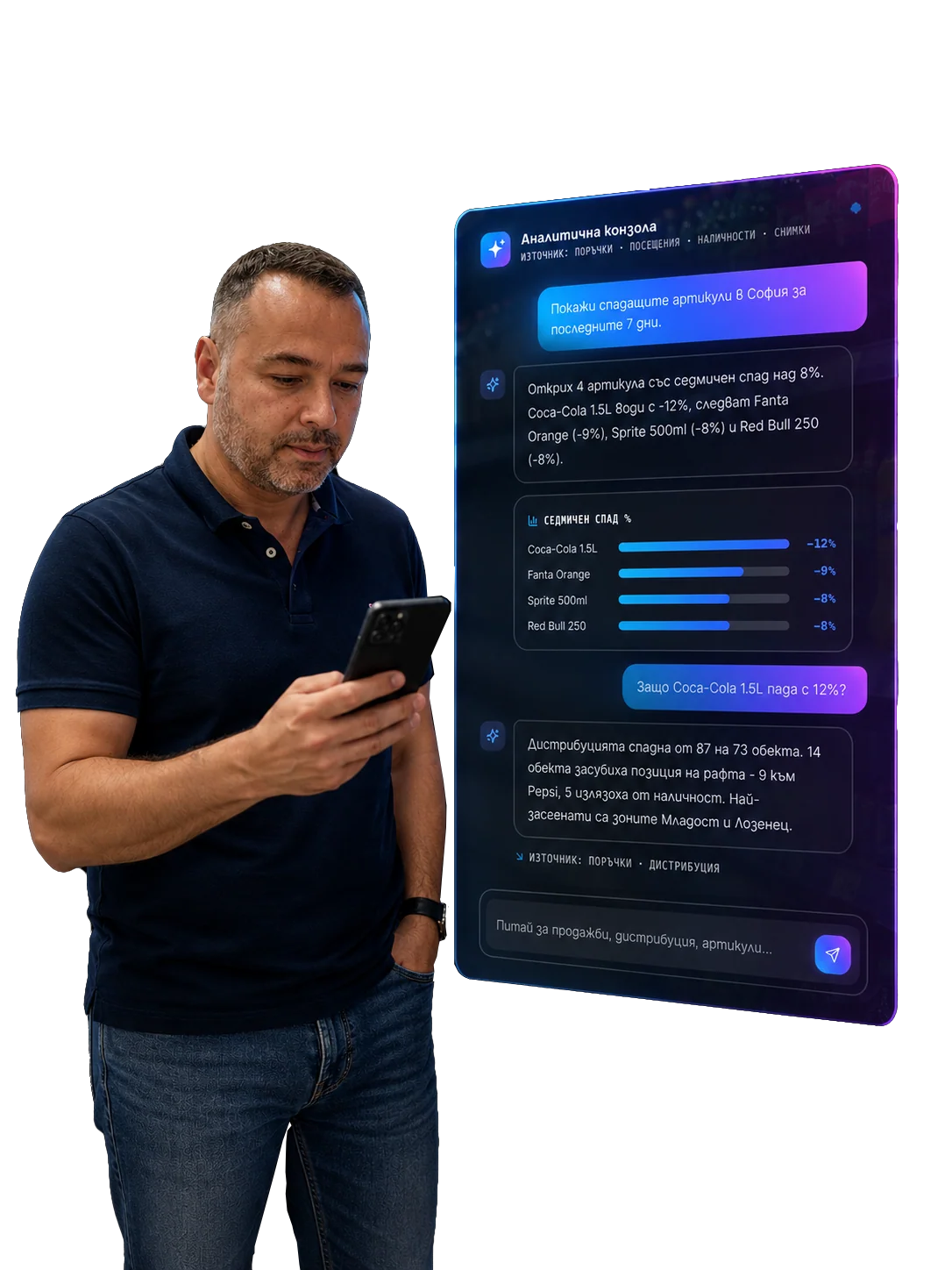
Chat BI, for example, should clearly show that the user receives an AI-assisted answer, not a human analysis. If the system generates text, summaries or action recommendations, this should be transparent.
This does not mean a heavy legal screen. It means clear, understandable labeling and governance.
Risk map for FMCG AI solutions
A practical way to think about the AI Act is to build a risk map by function.
| AI function | Typical risk | What should exist |
|---|---|---|
| Shelf image recognition | low/limited | confidence, human review, photo audit trail |
| Recommended order | low/operational | explainability, reason codes, override |
| Route optimization | low/operational | business rules, human approval |
| Chat BI | transparency | clear AI disclosure, source context |
| AI agents | depends on autonomy | permission boundaries, logs, approval |
| Sales coaching | depends on use | must not become automatic employee evaluation |
| Employee scoring | potentially high-risk | risk assessment, human oversight, documentation |
This map should be maintained as a document, not as a verbal explanation from the vendor.
Human-in-the-loop is not a formality
The AI Act puts strong emphasis on human control in riskier scenarios.
But in FMCG this is also good business practice.
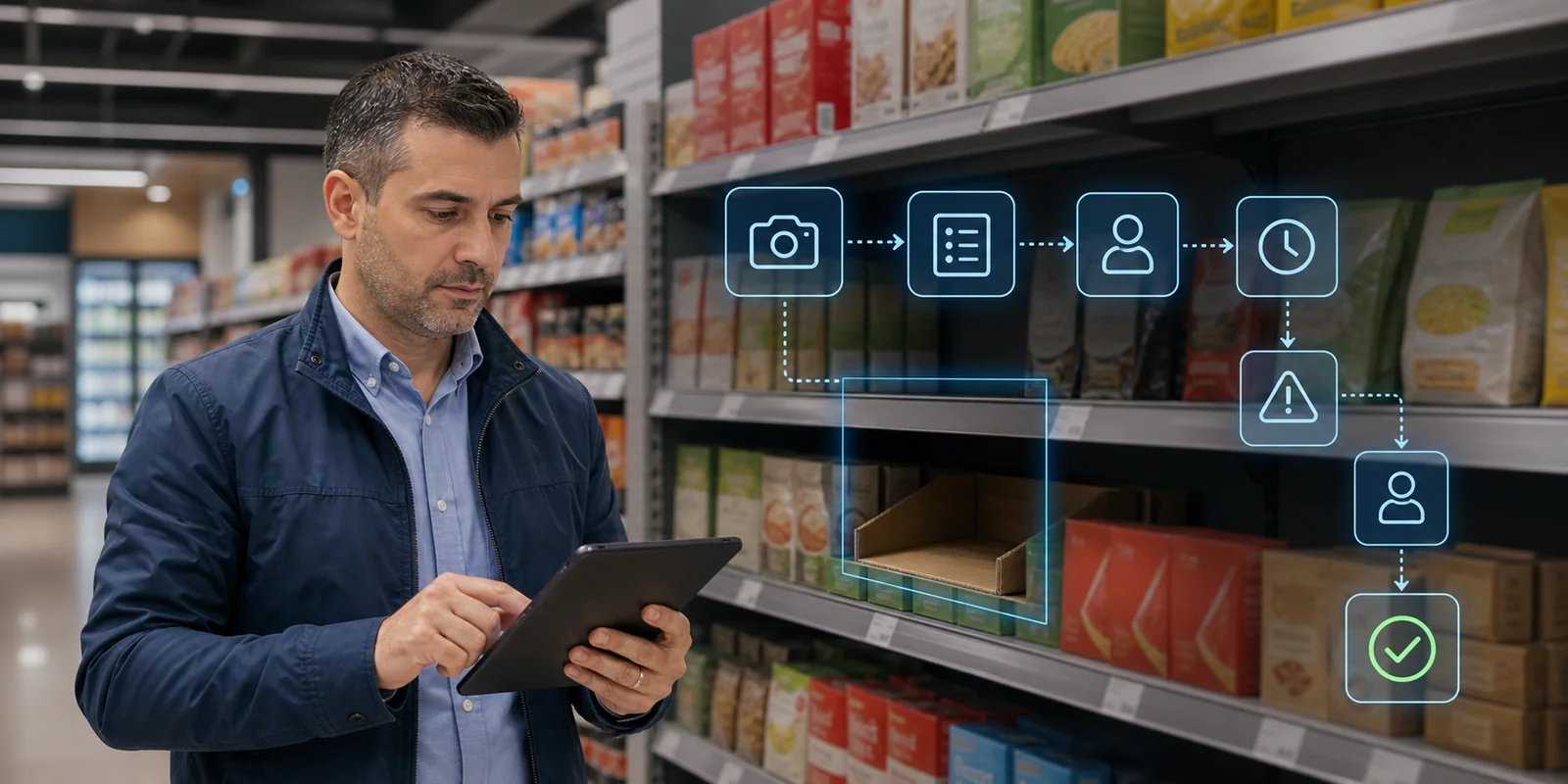
AI can suggest an order, but the sales rep must be able to correct it. AI can detect OOS, but the supervisor should see confidence and photo evidence. An AI agent can suggest an action, but workflow rules should determine when approval is required.
Human-in-the-loop AI is a strong operating principle:
- AI suggests;
- the human confirms or corrects;
- the system records the reason;
- the model learns;
- management sees the audit trail.
This makes AI manageable, not a black box.
What to ask your vendor
Before deploying AI in an FMCG platform, ask for concrete answers:
- Which AI components exist in the product?
- What risk classification exists for each component?
- Where is data processed?
- Is there EU data residency?
- Is an external LLM used?
- What data is sent to it?
- Is there an audit log of AI recommendations?
- Can the user challenge or correct AI output?
- How is AI-generated content labeled?
- What happens at low confidence?
- Are role-based access and permission boundaries in place?
- What is the roadmap against Article 50 and the high-risk timeline?
If the vendor answers only with “we are compliant”, that is not enough.
You need evidence.
What evidence means
Good AI governance documentation should include:
- AI inventory;
- risk classification;
- data flow diagram;
- model/provider information;
- logging policy;
- human oversight process;
- fallback behavior;
- data retention rules;
- security controls;
- vendor responsibility matrix;
- incident process;
- transparency UX.
AI governance in FMCG should be part of the platform, not a separate PDF nobody uses.
GDPR and the AI Act work together
The AI Act does not replace GDPR.
If AI processes personal data, GDPR still applies.
In FMCG, this may include:
- field sales rep data;
- GPS/visit history;
- performance metrics;
- customer owner contacts;
- images containing people;
- chat interactions;
- user behavior logs.
EU data residency, privacy-by-design, data minimization, audit trail and access control therefore matter not only for compliance, but also for trust.
In short
The EU AI Act does not prohibit AI in FMCG.
It requires AI to be:
- inventoried;
- classified by risk;
- transparent to the user;
- explainable when it affects action;
- managed with human oversight;
- logged;
- integrated with GDPR governance;
- supported by vendor evidence.
Companies that treat AI as a controlled execution layer will be in a better position than those buying “AI features” without governance.
Related in Optimasoft
- AI agents shows why permission boundaries and audit trails are critical for agentic AI.
- Chat BI is an AI interface where transparency and source context matter.
- AI Order Brain should combine recommendation, explainability and human correction.
- Workflow orchestration helps AI actions move through owner, approval and closure.
- Human-in-the-loop AI explains why human control is a business advantage, not a blocker.
- How to choose an SFA platform in 2026 includes AI governance as a buying criterion.
Sources
- European Commission - EU agrees to simplify AI rules to boost innovation and ban nudification apps
- EU Artificial Intelligence Act - Article 50 Transparency obligations
- European Commission - AI Act regulatory framework
- McKinsey - From blueprint to breakthrough: How AI and automation can transform the consumer enterprise
Related articles