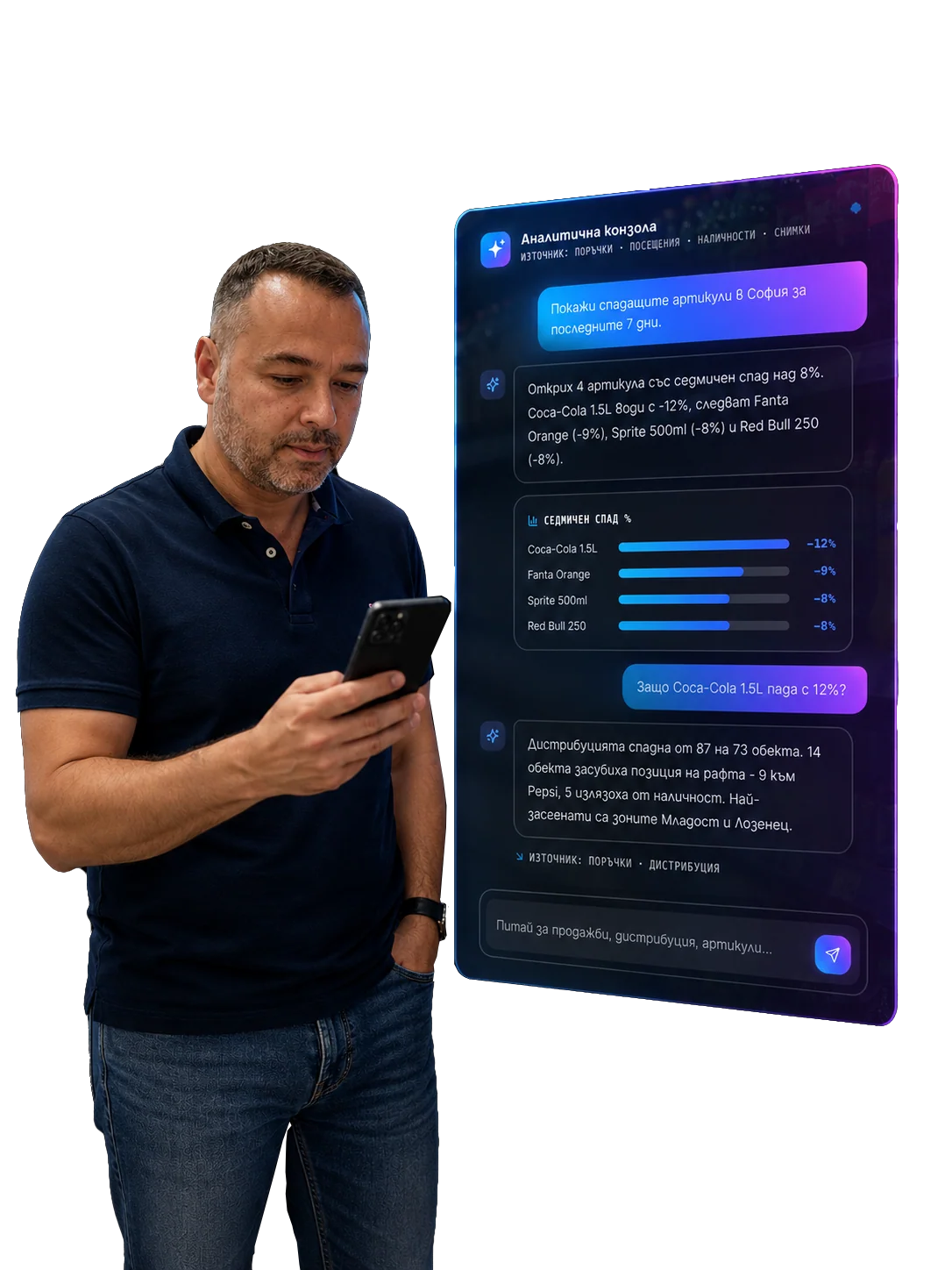
Sales coaching in FMCG: how AI helps representatives sell better
Good coaching is not generic advice like “sell more”. It shows a specific behavior, a specific gap and a specific next conversation the representative can handle better.
In many FMCG teams, coaching still sounds too generic.
"You need to sell more."
"Be more persistent."
"Explain the promotion better."
"Watch the shelf."
These statements may be true, but they are rarely useful enough. The representative already knows they need to sell more. The real question is where exactly they lose opportunity and what exactly needs to change in the next customer conversation.
Good sales coaching in FMCG is not a motivational speech.
It is behavior diagnosis.
What does the representative do inside the outlet that helps or hurts the sale?
AI can help exactly here, if used properly: not as a punishment system, but as a way to find the specific moments where the person needs support.
Why classic coaching arrives too late
In the traditional model, the regional manager sees results after a period:
- sales;
- number of visits;
- route execution;
- orders;
- target achievement;
- generic KPIs;
- impressions from ride-with visits.
Then they hold a meeting with the representative and give feedback.
The problem is that there is often too much time between behavior and feedback. If the representative rejected a recommended order, missed an OSA issue or failed to argue a new SKU, coaching two weeks later is already late.
FMCG field execution is fast. Feedback should also be fast.
Coaching should start from signal, not opinion
A good system does not say "this representative is weak".
It says:
- in which outlets a problem repeats;
- which types of recommendations are refused;
- which SKUs are missed;
- which tasks remain open;
- which route overrides repeat;
- which customers have similar objections;
- which promotions are not physically executed;
- where Perfect Store score falls.
That is different. The signal does not attack the person. It shows behavior that can improve.
Here Retail Execution KPI becomes the foundation for coaching. KPIs are not only for control. They should show what to train.
The most important coaching signals in FMCG
1. Recommended order overrides
If AI Order Brain recommends a quantity and the representative systematically reduces it, that is an important signal.
But we should not automatically assume the representative is wrong.
Possible reasons differ:
- the customer has cash flow issues;
- the model misses local context;
- the promotion is not convincing;
- the representative does not trust the recommendation;
- the customer had bad overstock experience;
- a competitor has taken visibility;
- the product is often missing and the customer does not want risk.
Coaching should help the representative argue the order, but also send quality feedback back to the system.
The stronger coaching topic is not:
"Accept more AI recommendations."
The stronger topic is:
"When the recommendation is for an SKU with OSA risk, here is how to explain why the quantity matters and how to record the refusal correctly."
2. OSA misses
If image recognition detects shortages that the representative did not mark or turn into action, that is a coaching signal.
Not because the person is "bad". Maybe they:
- do not know which SKUs are critical;
- look at the shelf too generally;
- do not have a good shelf-scan habit;
- do not understand the link between OSA and order;
- do not have a clear action when a shortage appears.
Coaching here should be specific:
- which products to check first;
- how to capture the image correctly;
- how to separate out-of-shelf from out-of-store;
- how to create follow-up;
- how to change the order;
- when to escalate to supervisor.
3. Promo execution gaps
Promotion is a strong coaching area because it combines selling and execution.
The representative may know the promotion exists, but fail to check:
- whether the price is placed;
- whether the display exists;
- whether there is enough stock;
- whether the right SKU is included;
- whether POS material is visible;
- whether the customer understands the mechanics.
A useful coaching point is:
"For promotions in this channel, first check price tag and secondary placement, then argue replenishment based on expected speed."
That helps. Generic "watch promotions" does not.
4. Route discipline and priority
Sometimes the problem is not the sales conversation, but which outlets receive attention.
If the representative often misses high-priority outlets, visits low-impact outlets first or makes route overrides without reason, coaching should explain why priority matters.
Field sales visit planning shows that the daily route is not just a map. It is a commercial decision.
Coaching signals can include:
- missed critical visits;
- delayed promotion check;
- frequent visits to stable low-potential outlets;
- missing follow-up to a high-risk customer;
- mismatch between route plan and execution result.
5. Issue closure
If the representative detects problems but does not close them, that is also a coaching topic.
Maybe they do not know who owns the issue. Maybe they do not understand when an issue is closed. Maybe there are too many tasks. Maybe the system is unclear.
From checklist to action loop is the key frame here: a task is not completed when it is marked. It is completed when the problem is closed with evidence.
How AI makes coaching more specific
AI can help at three levels.
1. Detects patterns
A person can see an individual case. AI can see recurrence:
- the same type of refusal;
- the same category;
- the same customer segment;
- the same shelf miss;
- the same override pattern;
- the same problem owner.
This makes coaching more precise.
2. Suggests the next conversation
Generative AI can help with a short script, but only if it is based on real context.
Example:
"The customer refuses additional quantity because they are afraid of overstock. Show that in the last two visits the product was out of stock before the next delivery and propose a smaller increase with a clear reason."
That is useful. A generic sales script is not.
3. Measures improvement
After coaching, the business should see whether behavior changes:
- accepts more high-quality recommendations;
- records better reason codes;
- closes follow-up;
- improves OSA;
- improves Perfect Store score;
- reduces repeated issues;
- increases conversion for new SKU.
Without measurement, coaching remains a good intention.
How not to turn AI coaching into punishment surveillance
This matters.
If representatives feel AI coaching is a control and sanction tool, they will bypass it.
The good model should be transparent:
- which signals are used;
- why a coaching topic is proposed;
- how the representative can explain context;
- what is recommendation and what is requirement;
- what data is stored;
- who sees the results;
- how the information is used.
AI coaching should help the person become better, not reduce them to a score.
What the representative should see
The representative does not need a complex coaching dashboard.
They need something short and specific:
- main focus for the week;
- 2-3 outlets where the new approach should be applied;
- concrete argument for customer refusal;
- important SKU or category;
- example from a real visit;
- how improvement will be measured.
Example:
Focus: arguing recommended order when OSA risk exists.
That is enough. One good topic is stronger than ten generic recommendations.
What the supervisor should see
The regional manager should see:
- coaching topics by person;
- coaching topics by team;
- recurring objections;
- behavior patterns;
- improvement after coaching;
- who needs a ride-with;
- who needs product or category knowledge;
- who needs process coaching;
- which signals are systemic, not individual.
Supervisor dashboard should surface these signals without flooding the manager. The goal is not simply to see weakness, but to know how to help.
A practical coaching framework
A working AI-assisted coaching frame can look like this:
| Step | Question | Example |
|---|---|---|
| Signal | What repeats? | Reduces recommended order when OSA risk exists |
| Context | Where does it happen? | Small convenience outlets, beverage category |
| Cause | What is the likely reason? | Customer fears overstock |
| Coaching | What conversation should happen? | Argument with previous shortage and smaller increase |
| Practice | Where should they try it? | 3 high-risk outlets this week |
| Measure | What do we track? | acceptance rate, OSA recovery, reason codes |
That is coaching that can change behavior.
In short
Sales coaching in FMCG should become more specific, faster and more connected to real execution.
Good coaching does not only ask:
"Who missed the target?"
It asks:
"Which behavior causes missed sales and how do we help the person change it?"
AI can help when it uses real signals:
- recommended orders;
- overrides;
- customer refusals;
- OSA issues;
- promo execution;
- route discipline;
- issue closure;
- Perfect Store score;
- follow-up quality.
The representative does not need another score.
They need a better next conversation.
Related in Optimasoft
- Sales coaching is the solution page for AI-assisted coaching, behavior signals and personalized support.
- AI Order Brain provides recommended order and override signals for coaching.
- Image recognition provides shelf and OSA signals that show where the representative needs support.
- Supervisor dashboard shows how these coaching signals reach the regional manager.
- FMCG sales representative 2.0 places coaching inside the full AI-assisted sales day.
Sources
Related articles