Retail Execution KPI in FMCG: which metrics actually drive sales
Weak KPIs measure activity. Strong KPIs show whether the outlet became better after the visit: better availability, better execution, better orders and less missed sales risk.

In FMCG, almost everything can be measured.
How many visits were completed. How many photos were uploaded. How many tasks were closed. How many orders were taken. How many kilometers were driven. How long the visit lasted. How many outlets were covered.
But that does not mean everything measured is important.
A field sales team can show strong activity and weak execution. It can complete many visits but visit the wrong outlets. It can upload many photos but fail to close shelf issues. It can take orders by habit. It can complete a checklist while the store itself does not become better.
That is why Retail Execution KPI in FMCG should start with a stricter question:
Which KPI proves that after the visit, the outlet is closer to the commercial strategy?
If a metric does not help answer that, it is probably an activity metric, not an execution metric.
The big difference: activity, execution and impact
Most FMCG companies start with activity metrics because they are easy:
- number of visits;
- number of photos;
- number of tasks;
- number of orders;
- GPS presence;
- time in outlet;
- route coverage;
- checklist completion.
These metrics are necessary. Without discipline there is no execution. But activity alone is not the result.
The real picture appears when the KPI model separates metrics into four levels.
1. Activity metrics
They show whether the team was in the field and whether the base process was completed.
Example: the representative visited 18 outlets, uploaded 42 photos, closed 30 tasks and took 14 orders.
That is control. It is not enough business diagnosis.
2. Execution quality metrics
They show whether the outlet was executed correctly.
Example: must-stock availability, facings, share of shelf, promo compliance, price compliance, asset compliance, secondary placement and Perfect Store score.
Here we start seeing the physical reality of the commercial strategy.
3. Commercial impact metrics
They show whether execution changes sales, risk or cost-to-serve.
Example: recovered OSA issue, uplift after promo correction, accepted recommended order, reduced out-of-stock risk, better route productivity and stronger weighted distribution.
This is the level management should really watch.
4. AI loop metrics
They show whether AI recommendations work inside the real process.
Example: recommended order acceptance rate, override reasons, shelf scan accuracy, issue closure after AI detection, route recommendation compliance and coaching improvement after a recommendation.
This is the new KPI category. If AI is being implemented, the business should not only measure whether the model "works". It should measure whether AI changes behavior and business outcomes.
KPI 1: Visit completion is not enough
The visit is the oldest and easiest KPI.
But "visited outlet" does not mean "improved outlet".
If the representative entered the store, but did not check the critical promotion, did not detect a missing hero SKU and took the same order as last week, the KPI may look green while the business loses.
The better KPI is not only visit completion. The better KPI is:
- visit completion by priority;
- visit completion for high-risk outlets;
- visit completion with critical task completed;
- visit completion with measured shelf signal;
- visit completion with a real action closed.
This is where route optimization matters. If the route is based only on geography, the team can be efficient logistically but weak commercially. In FMCG, the shortest route is not always the best route.
KPI 2: On-shelf availability
On-shelf availability is one of the most important retail execution KPIs because it is directly connected to missed sales.
The product may be available in ERP. It may be in the warehouse. It may even be inside the store. But if the shopper does not see it on the shelf at the moment of purchase, the sale is at risk.
That is why OSA should be measured by:
- SKU;
- category;
- outlet;
- channel;
- region;
- sales representative;
- promotion period;
- weighted importance according to outlet potential.
The big mistake is treating OSA as one generic percentage. A shortage in a small outlet and a shortage in a high-potential outlet do not carry the same weight. A missing slow-moving SKU and a missing hero SKU are also not the same.
The better KPI is weighted OSA risk: which shortages are most expensive for the business.
On-shelf availability is a large topic on its own, but inside the KPI framework it should sit in the center. If the product is not on the shelf, the other metrics lose meaning.
KPI 3: Perfect Store score
Perfect Store score is powerful only if it does not become bureaucracy.
A weak Perfect Store score is a long checklist that everyone completes but nobody uses for action.
A strong Perfect Store score measures a few conditions that actually move sales:
- right assortment;
- must-stock availability;
- right facings;
- right share of shelf;
- price and promotion;
- secondary placement;
- POS materials;
- asset compliance;
- clean shelf execution;
- action when there is a gap.
Weighting matters. Not every point is equally important. In beverages, the cooler can be more critical than a shelf strip. In personal care, share of shelf may matter more than a secondary display. In food, shelf life, availability and promo price may be decisive.
That is why Perfect Store should not be a universal checklist. It should be a scorecard by category, channel and commercial priority.
KPI 4: Promo compliance
Promotions are one of the largest sources of difference between plan and reality.
On paper, the promotion is active. In ERP, the price is loaded. In the presentation, the display looks good. In the store, however, there may be no:
- promo price;
- POS material;
- secondary display;
- right assortment;
- enough stock;
- right position;
- execution on the correct day.
If we only measure sell-in, we may believe the promotion started. If we measure physical execution, we see whether the shopper actually sees it.
That is why promo compliance KPI should include:
- planned vs executed outlets;
- display presence;
- price compliance;
- promo SKU availability;
- shelf or photo evidence;
- issue closure time;
- sales impact after correction.
Image recognition can help here because it turns the photo from proof into verification: is the display present, is the product there, is the price label visible, is there a visible deviation?
KPI 5: Share of shelf and facings
Share of shelf is a sensitive metric because it shows the real battle for visibility.
In FMCG, it is often not enough for the product to simply be present. If it is present with one facing, low on the shelf, between competitors and without a logical brand block, physical availability does not automatically become sales.
The KPI framework should look at:
- facings by SKU;
- facings by brand block;
- share of shelf vs category;
- vertical position;
- planogram compliance;
- competitor pressure;
- change over time.
This is where shelf computer vision becomes important, because manual assessment is slow, subjective and difficult to scale. If the business wants objective shelf KPI, the photo needs to become a measurable signal.
KPI 6: Recommended order acceptance rate
When AI recommends an order, the new important KPI is not only forecast accuracy.
In the commercial process, the more interesting questions are:
- how often the recommendation is accepted;
- when it is adjusted;
- why it is adjusted;
- which representative accepts or rejects it;
- which customers systematically refuse;
- whether accepted recommendations reduce OOS;
- whether adjusted recommendations produce better outcomes;
- which reason codes repeat.
This is recommended order acceptance rate.
It should not be used for punishment. If the representative rejects a recommendation, maybe the model missed context. If the customer refuses, maybe there is a cash flow issue, weak promo mechanics or low trust in the category. If the recommendation is accepted but creates overstock, the model needs correction.
AI Order Brain is strong exactly when the recommendation has reasoning and feedback. Without reason codes, AI order taking becomes a black box. With reason codes, it becomes a learning system.
KPI 7: Issue closure rate
Detecting a problem is not the same as solving it.
Many retail execution systems create an impression of control because they show many issues: missing SKU, wrong price, missing POS material, empty display, planogram violation.
But if issues remain open, the KPI should be red.
Better metrics are:
- issue closure rate;
- average time to close;
- repeated issue rate;
- reopened issue rate;
- closure by type;
- closure by region;
- closure by owner;
- commercial impact after closure.
This is where workflow orchestration has practical value. The problem should not remain just a note in a system. It should reach the right person, with the right deadline, the right evidence and a clear status.
KPI 8: Coaching improvement
Field sales coaching is often measured by completed trainings, meetings or ride-with days.
Those are activity metrics.
The stronger KPI is whether behavior improves after coaching.
For example:
- the representative starts accepting more high-quality AI recommendations;
- OSA issues in their outlets decrease;
- Perfect Store score improves;
- customer refusal reasons are captured more clearly;
- follow-up tasks close faster;
- promotions are executed more accurately;
- route discipline improves without hurting commercial outcomes.
Sales coaching should work with specific behavior patterns, not general impressions. "You need to sell more" is not coaching. "In 7 out of 10 cases you reduce the recommended quantity for a SKU with OSA risk; here is how to argue the order" is coaching.
KPI 9: Manager actionability
A dashboard can be beautiful and useless.
If the regional manager needs to look at 12 screens to understand where to act, the BI layer is not helping enough.
That is why there should be KPI for actionability:
- how quickly the manager understands top risks;
- how many issues become actions;
- how often a dashboard insight creates follow-up;
- which insights are ignored;
- which alerts are noise;
- which alerts lead to measurable impact.
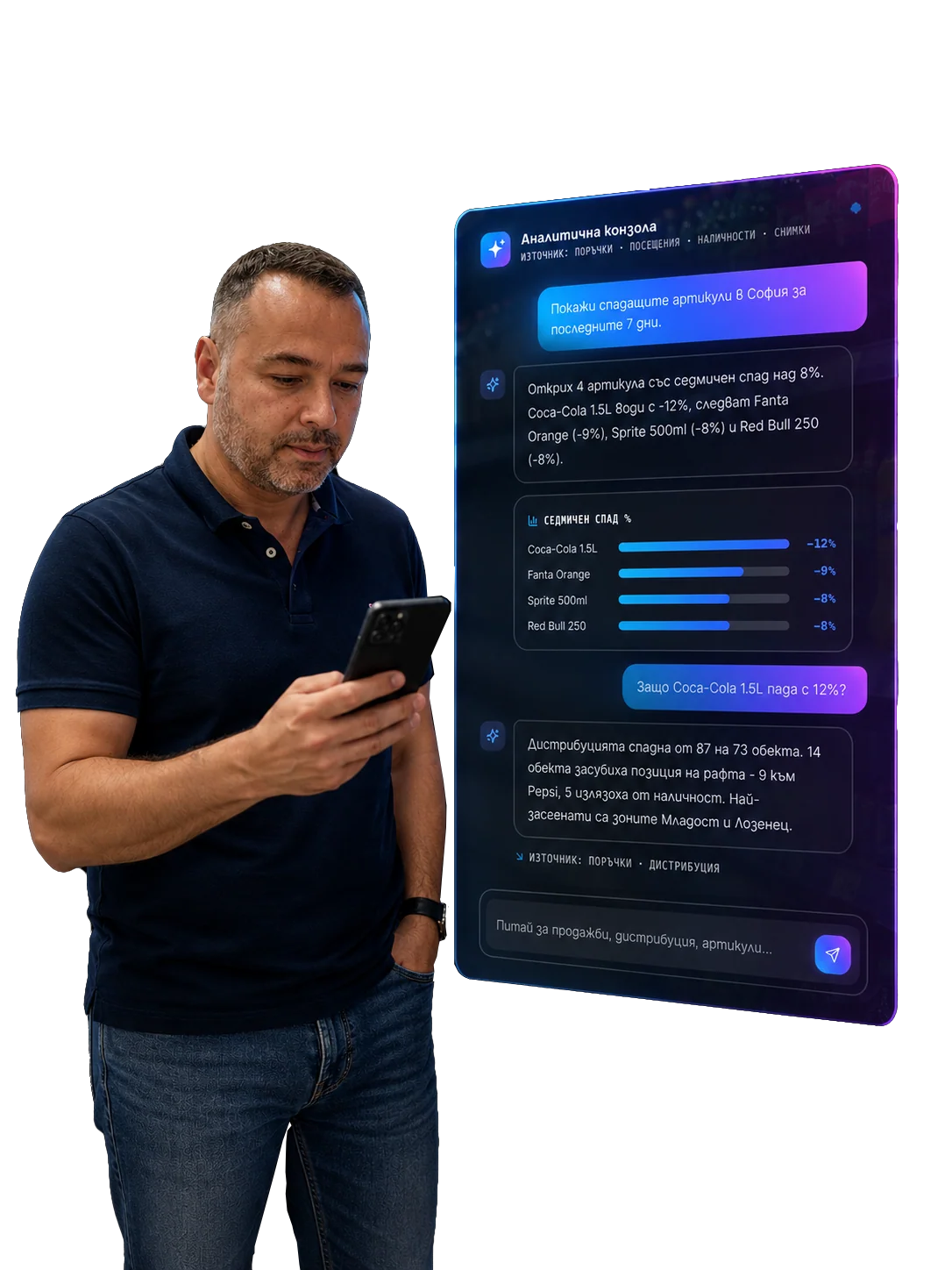
Chat BI can be very strong in this logic. The manager should not only look at charts. They should be able to ask:
"Which 20 outlets this week have the highest missed-sales risk and why?"
That is a different KPI culture: from reporting to decision support.
KPI 10: AI loop health
If the company uses an AI suite, it must measure the health of the AI loops themselves.
Not only model accuracy, but the full cycle:
- capture quality;
- model confidence;
- human review rate;
- recommendation acceptance;
- override reason quality;
- issue closure after detection;
- business impact after action;
- drift by category, region or season;
- audit trail;
- fairness and policy control.
This is especially important with AI agents. An agent can create a task, prepare a summary or escalate a problem, but KPI should show whether that helps or creates noise.
A good AI KPI does not only ask "was the model right?". It asks:
"Did the signal lead to a better action?"
How not to drown the team in KPI
The most dangerous thing is creating 80 KPIs and making all of them look important.
The field team cannot manage 80 priorities. Neither can the manager.
A better frame is role-based.
For the sales representative
They should see only a few concrete things:
- most important outlets for the day;
- top risks inside the visit;
- critical shelf issues;
- recommended order;
- next action;
- personal coaching signal.
For the supervisor
They should see:
- problem outlets;
- repeated issues;
- representatives needing coaching;
- unresolved tasks;
- promotions with execution risk;
- route exceptions.
For management
At management level, the KPI set should be even more focused:
- OSA risk;
- Perfect Store trend;
- promo compliance;
- recommended order impact;
- route productivity;
- issue closure;
- cost-to-serve;
- AI loop health.
A good KPI system does not show everything to everyone. It shows the right thing to the right person.
A practical FMCG retail execution scorecard
If we start pragmatically, a strong scorecard can look like this:
| KPI group | What it measures | Why it matters |
|---|---|---|
| Coverage quality | Visits by priority, channel and potential | Not all stores have equal value |
| OSA risk | Missing important SKUs in important outlets | Direct missed-sales risk |
| Perfect Store score | Assortment, availability, shelf, promotion, POSM | Whether strategy is physically executed |
| Promo compliance | Promo price, display, availability, timing | Whether promotion investment reaches the shopper |
| Shelf visibility | Facings, share of shelf, position | Whether the product is visible and protected from competition |
| Order quality | Recommended order acceptance, overrides, reason codes | Whether the order is a commercial decision, not routine |
| Issue closure | Closed issues, time to close, recurrence | Whether detected problems are actually solved |
| Coaching improvement | Behavior change after coaching | Whether the team becomes better |
| AI loop health | Confidence, acceptance, closure, impact | Whether AI helps the process instead of only creating signals |
This turns the KPI framework into a management system, not a list of numbers.
In short
Retail Execution KPI in FMCG needs to move from activity control to outcome control.
A weak KPI asks:
"How many things did we do?"
A strong KPI asks:
"What improved in the outlet and which risk did we reduce?"
The difference is large.
A real retail execution system should measure:
- whether the right outlets were visited;
- whether the right SKUs were on the shelf;
- whether the promotion was physically executed;
- whether the Perfect Store standard improved;
- whether the recommended order was accepted and worked;
- whether issues were closed;
- whether coaching changed behavior;
- whether AI signals led to action;
- whether the manager knows where to intervene.
FMCG companies will not win from more dashboards. They will win from KPIs that drive better execution in the outlet.
Related in Optimasoft
- Optimasale is the field layer where KPI connects to visits, tasks, orders and execution.
- Image recognition provides objective shelf signals for OSA, facings, share of shelf and promo compliance.
- AI Order Brain adds KPI for recommended order acceptance, overrides and reason codes.
- Sales coaching turns KPI gaps into specific behavior improvement.
- Chat BI helps managers ask the data for next best action, not only look at reports.
- FMCG sales representative 2.0 shows how these KPIs are used in the real day of a field representative.
Sources
- Bain & Company - Perfecting Sales Execution
- Bain & Company - Perfect Store: How advanced analytics is transforming sales execution
- NielsenIQ - Can the FMCG industry afford to lose billions from empty shelves?
- ECR Europe - Optimal Shelf Availability
- Corsten & Gruen - Retail Out-of-Stocks: A Worldwide Examination of Extent, Causes and Consumer Responses
- McKinsey - The State of AI: Global Survey 2025
Related articles