AI order taking in FMCG: why suggested orders matter more than automatic orders
Automatic ordering sounds like the future. In real FMCG field execution, the stronger step is often the suggested order: AI recommends quantities with reasons, while the sales rep keeps control.
There is a phrase in FMCG that sounds modern but is often framed too early: automatic ordering.
At first glance, the idea makes sense. If AI knows order history, stock, promotions, seasonality and store behavior, why should the sales rep enter the order at all? Let the system create it.
That sounds good in a presentation. In the field it is more complicated.
A store is not a spreadsheet. The owner may have no budget this week. The fridge may be broken. A competitor may have made an aggressive offer. The promotional display may not be installed. The sales rep may know there is a local event on Friday. Or the opposite: the system may see a signal the human misses.
That is why in many FMCG processes the strongest step is not “AI orders instead of the human.”
The stronger step is:
AI suggests an order with a reason, and the human makes the final decision.
That is the difference between automation that sounds impressive and an execution system people actually use.
The problem is not order entry
Classic SFA digitized order taking. Sales reps no longer write on paper. Orders enter faster. Transcription errors fall. Managers see the result.
That matters, but it solves only the surface.
The real problem is not that orders are entered slowly. The real problem is that orders are often taken by habit.
The sales rep enters the store and orders “the usual.” The owner says “same as last time.” The system shows history. Everything looks normal.
But FMCG is rarely normal:
- sell-out has increased, but nobody noticed;
- a promotion starts in two days, but the order does not cover the promo week;
- the SKU is on the shelf, but only with one facing and will disappear tomorrow;
- the store has high potential, but is treated as average;
- a top product is missing, while the order is built around secondary SKUs;
- the rep under-orders because they do not want an argument with the customer;
- the customer refuses part of the range because nobody explains why it matters.
That is where sales are lost. Not in the entry form.
Why “the usual” is an expensive habit
The out-of-stock problem is well studied enough that it should not be treated as anecdotal.
The classic Corsten and Gruen study reports an average worldwide out-of-stock level of around 8.3%. More important is the shopper response: some customers switch stores, some switch brands, some delay the purchase and some do not buy at all. The missing product is not simply “sold tomorrow.” Often, the sale moves elsewhere.
At the same time, distribution is not measured only by whether a product is present in many outlets. NielsenIQ explains the difference between numeric distribution and weighted distribution: what matters is not only how many stores carry the product, but which stores they are and how much they matter for the category. The same logic applies to ordering. It is not enough that an order exists. The right store needs the right quantity of the right SKUs.
This is where “the usual” becomes dangerous.
It does not understand potential. It does not understand risk. It does not understand promotional windows. It does not understand that two stores with similar history may have very different weeks.
Automatic order vs suggested order
We need to separate three levels because they are often mixed in practice.
Order entry is the digital capture of the order. This is standard SFA: catalog, prices, stock, discounts, confirmation.
Suggested order or recommended order is an AI/analytics recommendation: the system proposes SKUs and quantities, explains why, and lets the sales rep accept, adjust or reject.
Autonomous order is an order created by the system inside predefined rules, sometimes without human confirmation.
All three have a place. But not in the same situations.
Automatic ordering is suitable for stable, predictable, lower-risk scenarios: repeat replenishment, limited assortment, clear minimum and maximum stock levels, good sell-out data and low business risk if the system is wrong.
FMCG field sales is often not that scenario. Especially in general trade, distributor-led channels, small stores, HoReCa, seasonal categories, promotion weeks and markets with incomplete data.
There, suggested order is the stronger model because it combines two things:
- AI sees more signals than the human;
- the human sees context the system does not yet know.
That is not a compromise. It is the right architecture for controlled autonomy.
What a good AI order should read
A suggested order should not be “last order plus a little.” That is spreadsheet logic, not AI-native logic.
A good recommendation combines several signal layers.
Order history. What the outlet bought, how often, in what quantities, on which days and under which promotions.
Sell-out or proxy signals. If true sell-out exists, it is the strongest signal. If not, the system needs to work with proxies: replenishment frequency, shelf photos, drop size, returns, promo participation, seasonality and similar outlets.
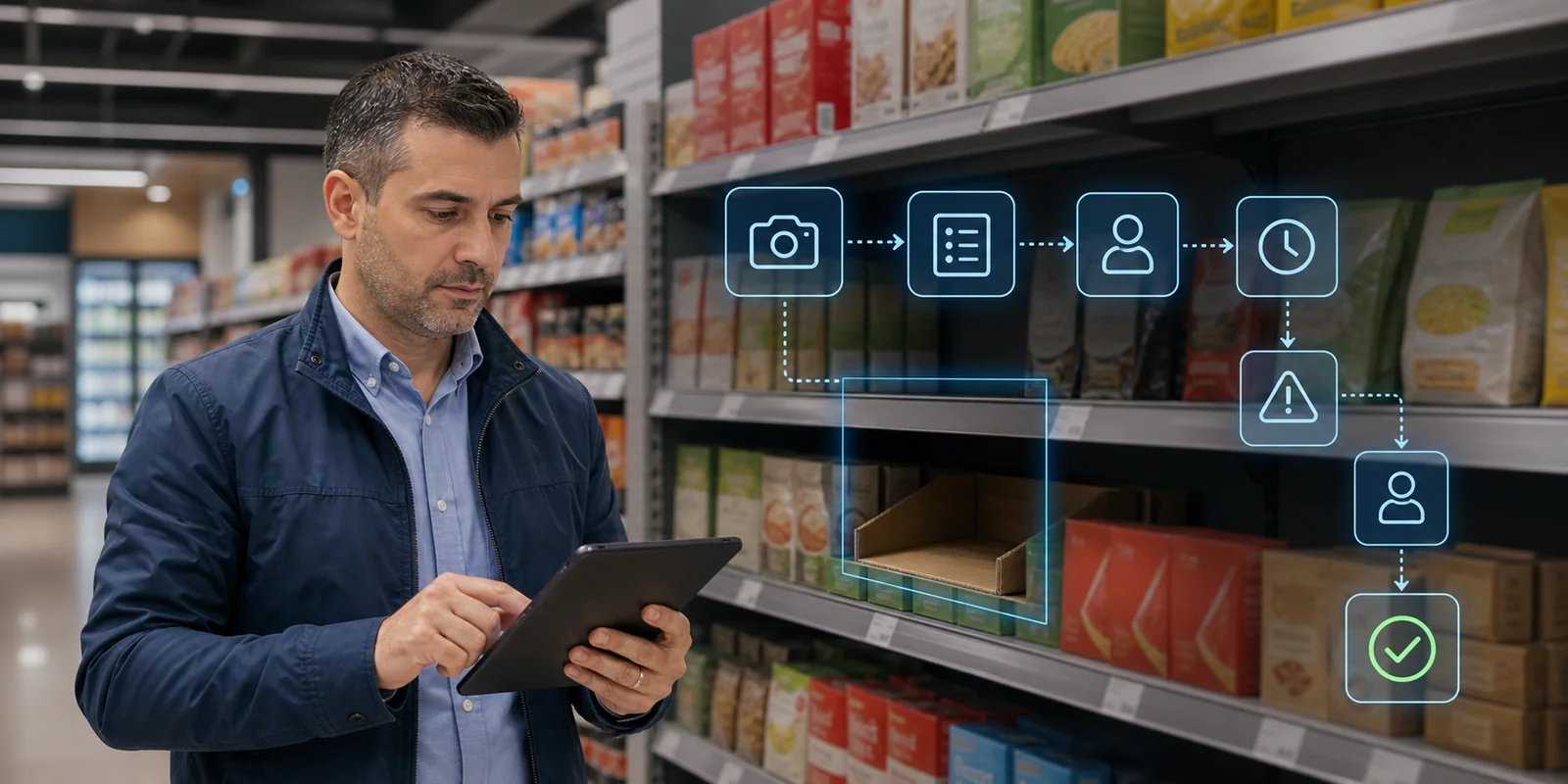
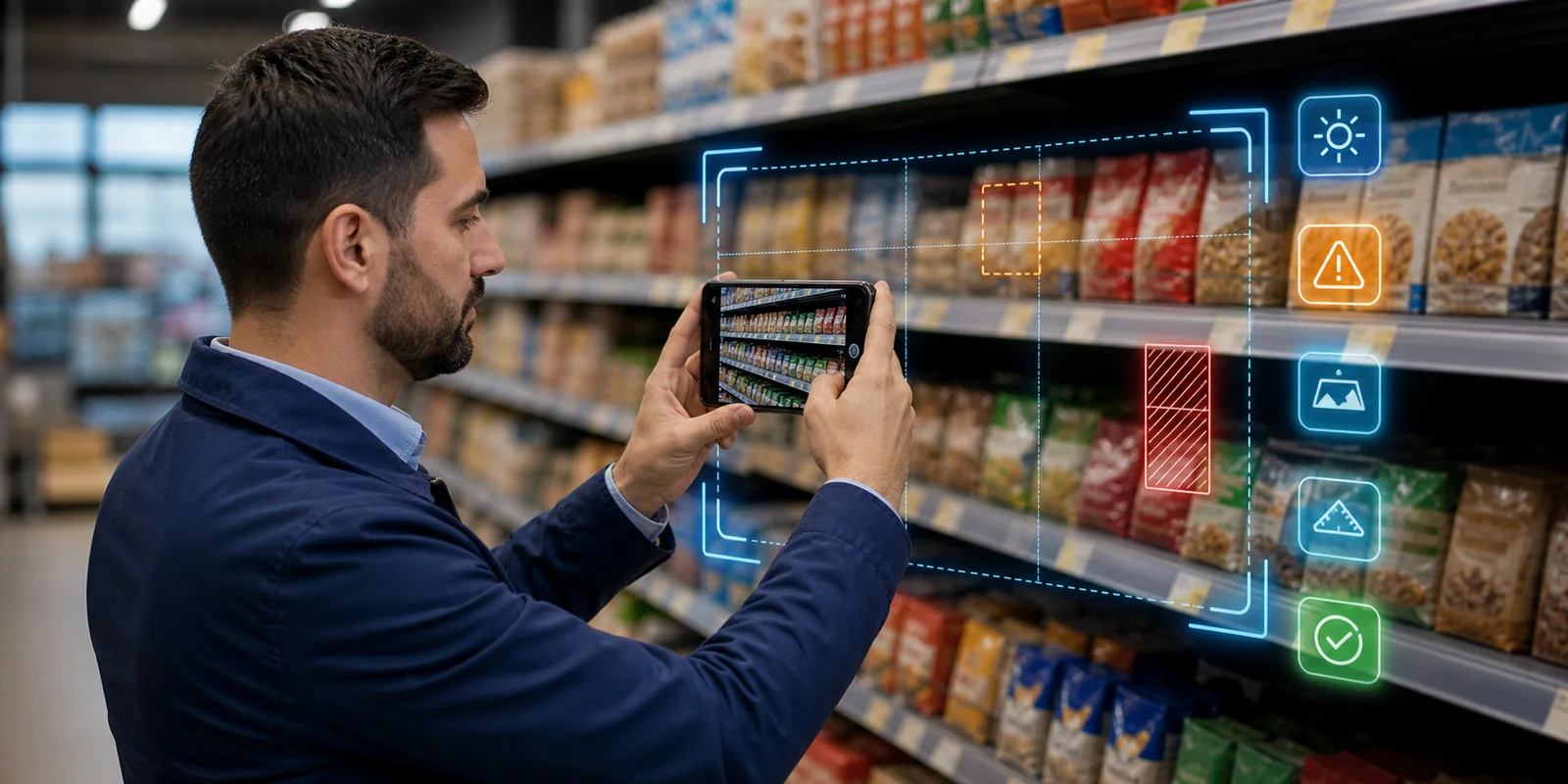
Stock and shelf signals. Computer vision can show whether the product is actually on the shelf, how many facings it has, whether there is empty space and whether the promotional display is installed. That changes the order. If the product is poorly exposed, the problem may be execution, not quantity.
Promotion calendar. Promotions change demand, but not equally in every store. AI must look not only at whether there is a promotion, but whether this store historically responds to this type of promotion.
Seasonality and local context. Water, beer, ice cream, coffee, personal care and impulse categories all have different rhythms. Local context matters: holidays, weather, events, tourist flow and school season.
Customer profile. A high-potential store with low current coverage should not receive the same recommendation as a low-potential store with stable small volume.
Commercial rules. Prices, discounts, minimum quantities, credit limits, overdue payments, agreements, warehouse availability and logistics capacity.
Company priorities. If the strategy is to protect a hero SKU, expand a must-stock list or increase penetration of a new product, the recommendation should know it.
That is why AI order taking is not one model. It is a decision layer over sales execution, inventory, trade terms, route-to-market and retail reality.
“12 units” is not enough
The big problem with many AI systems is that they provide a result but not a reason.
For the sales rep, that does not work.
If the system says “order 12,” the rep will ask: why 12? Why not 6? Why not 24? Why this SKU?
That is why suggested orders need to be explainable in human language:
“We recommend 12 units because the last two visits show higher sell-out, the promotion starts on Friday, and current stock covers roughly 4 days.”
Or:
“Add this SKU: similar stores in the same segment sell the category, and this outlet has shelf space and low must-stock coverage.”
Or:
“Do not increase quantity: the problem is shelf visibility, not demand. Restore position first.”
This is very different from “AI said so.”
The explanation has three jobs:
- it helps the sales rep sell the recommendation to the customer;
- it builds trust in the system;
- it enables control when the recommendation is wrong.
Without a reason, the recommendation is a black box. With a reason, it becomes a tool.
How the rep should work with the recommendation
The best UX for AI order taking is not a huge dashboard.
The rep does not have time for that. They are in the store.
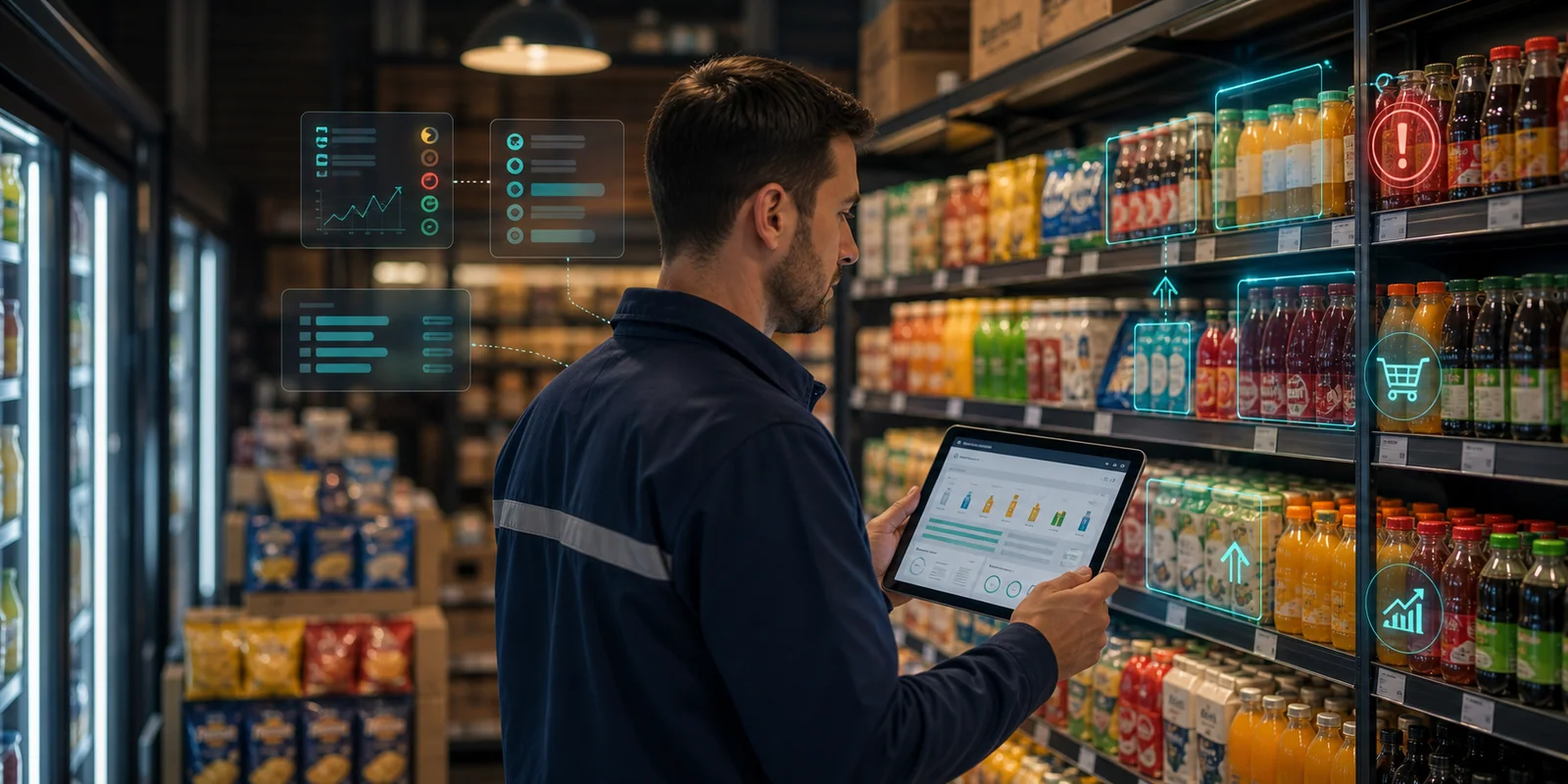
The right interface should be practical:
- proposed SKUs and quantities;
- the reason behind each important change;
- risk indicators: OOS, overstock, promotion, credit, low shelf visibility;
- fast actions: accept, adjust, reject;
- reason codes when changing the recommendation: “customer refused,” “no space,” “no budget,” “local event,” “competitor offer”;
- manager visibility into where AI and human judgment diverge.
The last point is critical.
If sales reps constantly correct the system’s recommendations, that is not automatically a failure. It is a data signal. Either the model is wrong, or there is context not being captured, or the incentive system is pushing behavior in another direction.
AI order taking should learn from the gap between recommendation and real action.
Where automatic ordering makes sense
This is not an argument against automation. Automatic ordering has a place.
But it should start where risk is controlled.
For example:
- stable, high-frequency SKUs with predictable demand;
- internal replenishment scenarios;
- customers with clear min/max rules;
- low-risk top-up quantities;
- reorder of products that are consistently accepted without correction;
- automatic drafting of an order that a human only reviews.
A good platform does not treat all orders the same. It uses different levels of autonomy depending on risk.
A recommendation can be:
- a hint only;
- a pre-filled order;
- an order for approval;
- automatic execution within defined limits;
- blocked if it violates policy.
That is a more mature model than “everything manual” or “everything automatic.”
How to measure whether it works
AI order taking should not be sold as a “more modern process.” It should be measured as a commercial result.
Several metrics matter.
Acceptance rate. How often reps accept the recommendation without changes. But this should not be the target by itself. High acceptance can mean trust, but it can also mean passivity.
Override quality. When the human is right to correct AI and when not. This is more important than simply counting overrides.
OOS reduction. Do out-of-stocks decrease for key SKUs and stores?
Order accuracy. How close is the order to real demand after the period?
Drop size and mix. Does the average order grow where there is potential, without filling the channel with the wrong stock?
Returns and overstock. AI should not lift sales on paper by moving the problem to the customer.
Time in store. If the recommendation is good, the rep should not spend more time on administration. They should spend more time on conversation and execution.
Revenue and gross margin uplift. Ultimately, the recommendation must improve sales and margin, not only look smart.
McKinsey often frames the value of AI forecasting through lower forecast error, better availability and lower inventory. Gartner frames the supply-chain shift in a similar way: agentic AI will enter more decisions, but value appears only when the systems are tied to real workflow and control.
In other words: AI order taking matters only if it changes the order in a way that shows up on the shelf, in the warehouse and in revenue.
The biggest risk: automating a weak process
If current order taking is weak, AI will not automatically make it good.
It may simply accelerate the wrong behavior.
If master data is inaccurate, AI will recommend the wrong SKUs. If the promotion calendar is not synchronized, AI will under- or overestimate demand. If the sales rep has no reason to follow the recommendation, they will ignore it. If the manager looks only at turnover, but not at OOS, returns and margin, the model will optimize the wrong behavior.
That is why the first step is not “add AI.”
The first step is to clarify:
- which SKUs are critical;
- which customers are priority;
- which signals are reliable;
- which decisions AI may recommend;
- which decisions must remain human;
- how the result will be measured;
- how the system will learn from rejections and corrections.
AI order taking is only as strong as the operating discipline around it.
What a good process looks like in practice
Imagine a store visit.
The sales rep enters. The system already knows this outlet is in a promotion week, has high category potential and the last two visits showed risk of two hero SKUs going out of stock.
The rep photographs the shelf. Computer vision confirms that one SKU has low visibility and the other is nearly depleted. The AI order taking module proposes an order:
- increase quantity for SKU A because current availability covers fewer days than the next visit cycle;
- add SKU B because it is part of the must-stock list and similar stores sell it;
- do not increase SKU C because the issue is shelf position, not demand;
- propose a bundle because this customer historically accepts promotional mixes.
The rep accepts part of the recommendation, adjusts another part and gives a reason: “customer has a budget limit this week.”
Later, the manager sees not only the order, but the gap between AI recommendation and human decision. If similar refusals repeat across many stores, that becomes an insight: maybe the promo mechanic is weak, credit limits are too tight or the model overestimates the category.
That is the real effect. The order is no longer a single action. It becomes a feedback loop.
Why this matters more than full automation
Full automation is the endpoint for some scenarios, but it is not the best starting point for FMCG sales execution.
Suggested order matters more because:
- it improves decision quality without removing human context;
- it helps the sales rep argue the order with the customer;
- it captures why recommendations are accepted or rejected;
- it reduces black-box risk;
- it enables controlled autonomy by category, customer and situation;
- it turns order taking from an administrative task into a commercial decision.
Automatic ordering asks: can the system order instead of the human?
Suggested ordering asks a better question:
What should we order, why exactly that, and how do we help the human make a better decision now?
In FMCG, that “now” is everything.
Because if the right product does not reach the right shelf on time, the AI strategy does not matter. The sale is already gone.
Related in Optimasoft
- AI Order Brain is the solution page for suggested orders, reason codes and controlled autonomy in order taking.
- Optimasale connects the suggested order to the visit, customer, prices and field execution.
- On-shelf availability shows why shelf signals should influence quantity recommendations.
- Route-to-Market places order taking inside the broader context of coverage, frequency and cost-to-serve.
Sources
- Corsten & Gruen - Retail Out-of-Stocks: A Worldwide Examination of Extent, Causes and Consumer Responses
- NielsenIQ - Total Distribution Points and CPG brands
- McKinsey - The State of AI: Global Survey 2025
- McKinsey - Succeeding in the AI-powered supply-chain revolution
- Bain - How advanced analytics is transforming sales execution
- Gartner - Half of supply chain management solutions will include agentic AI capabilities by 2030
- European Commission - AI Act regulatory framework
Related articles