AI agents in FMCG: what they can do and what they should not do
AI agents can reduce follow-up noise, prepare summaries, escalate issues and track deadlines. But without rules, owner and audit trail, they quickly become risk.

AI agents are one of the strongest, but also easiest to exaggerate, topics in enterprise software.
It sounds attractive: the agent monitors, decides, acts, escalates, writes, coordinates and closes tasks.
But in FMCG, reality is more concrete.
There are no abstract processes. There are outlets, representatives, shelves, orders, promotions, distributors, customers, coolers, credit limits and open issues.
An AI agent can be very useful if it helps the process move faster and cleaner.
It can also be dangerous if it starts acting without clear rights, owner, evidence and audit trail.
So the good question is not:
"Can we automate this with an agent?"
The good question is:
"Which part of this FMCG workflow can be safely delegated, with control and measurable result?"
What an AI agent is in this context
In FMCG retail execution, an AI agent should not be imagined as a robot.
It is more useful to think of it as a software worker with:
- a specific task;
- access to limited context;
- clear rules;
- action rights;
- limits;
- action log;
- owner;
- escalation to a human when uncertain.
For example, the agent can:
- create a follow-up task;
- prepare a summary;
- check whether an issue is recurring;
- suggest next best action;
- send a reminder;
- group problems by region;
- prepare supervisor brief;
- check whether approval is needed.
These are real, useful tasks.
Good AI agent use cases in FMCG
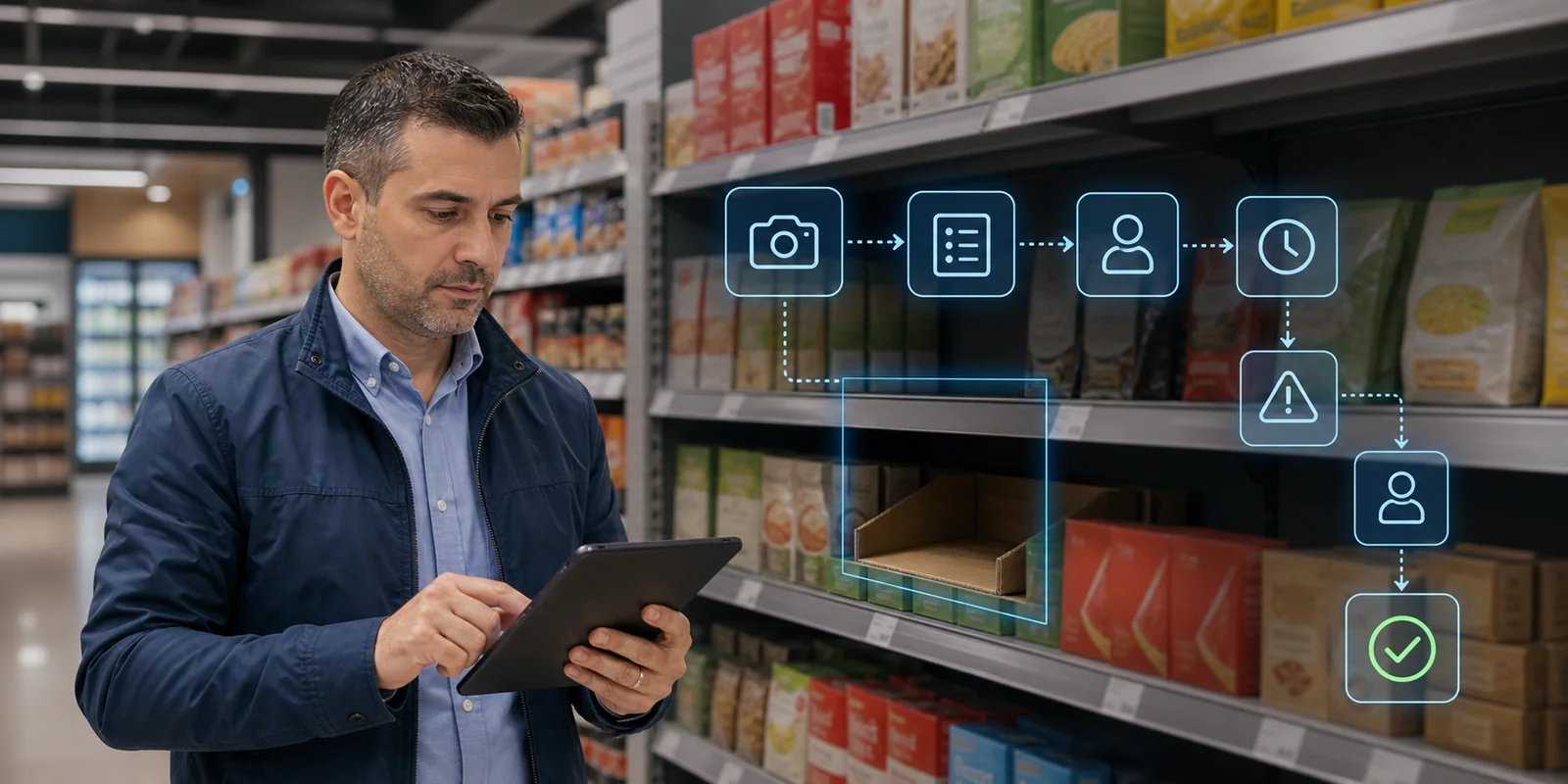
1. Follow-up after visit
After every visit, small but important actions may remain:
- the customer refused a must-stock SKU;
- promo display is missing;
- the photo showed an OSA problem;
- the cooler is in the wrong place;
- order recommendation was changed;
- supervisor needs to check an agreement.
An AI agent can prepare a follow-up task with context, owner and deadline.
This saves admin time and reduces the risk that the problem gets lost.
2. Issue triage
Not every problem should be escalated the same way.
The agent can classify:
- critical;
- repeated;
- low priority;
- needs supervisor;
- needs trade marketing;
- needs distribution;
- needs finance;
- needs customer follow-up.
This is especially useful with large volume of shelf, promo and asset issues.
3. Supervisor brief
The regional manager does not have time to read everything.
The agent can prepare a morning brief:
- top risks;
- critical outlets;
- overdue issues;
- route exceptions;
- coaching topics;
- promotions with risk;
- recommended order patterns.
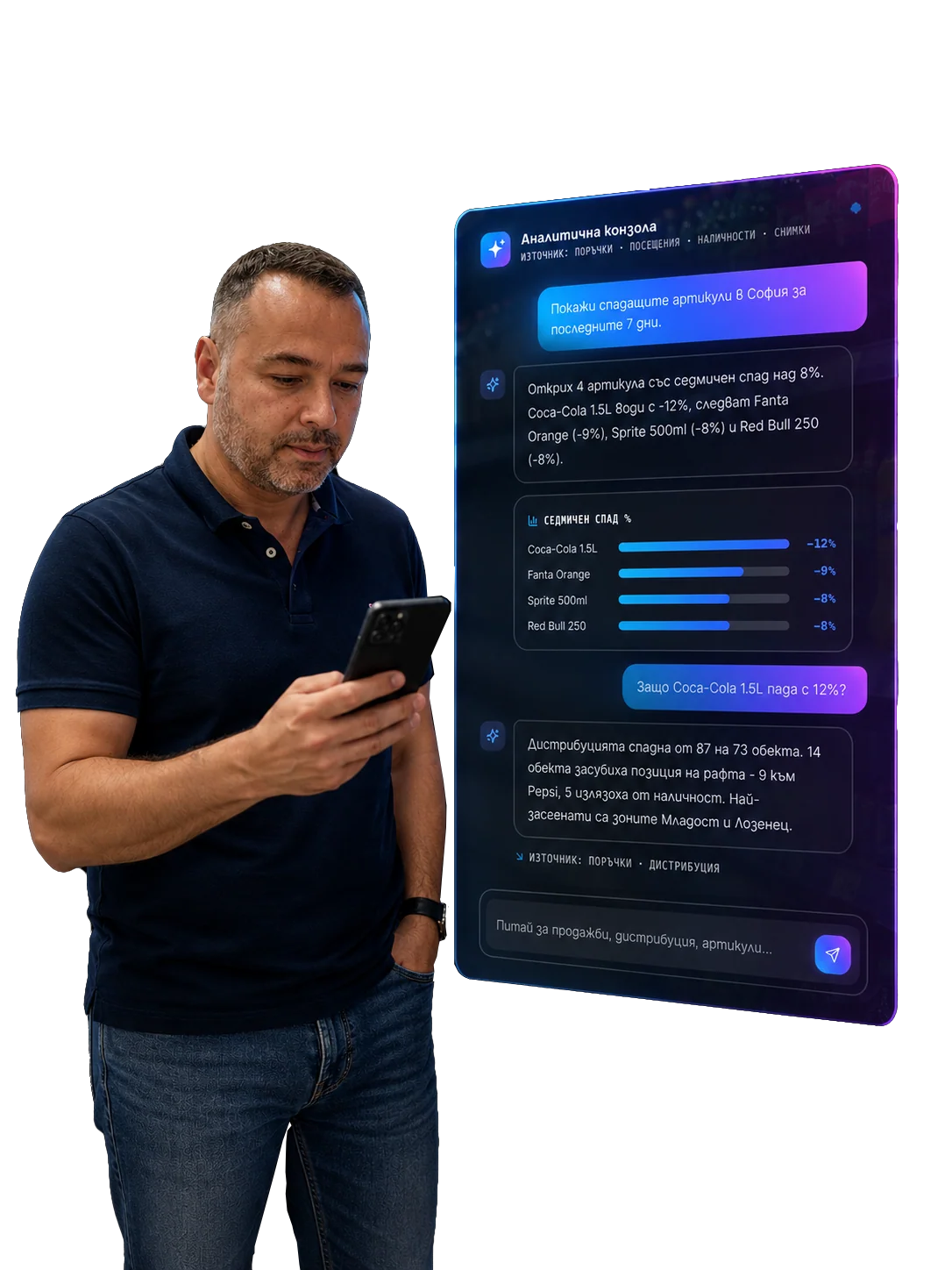
Supervisor dashboard shows why this matters: the manager needs intervention, not noise.
4. Recurring problems
An isolated shortage is a task.
A recurring shortage across many outlets is a process issue.
An AI agent can detect a pattern:
- the same SKU missing in a region;
- the same promo price not installed;
- the same distributor creating stock gaps;
- the same representative having many unresolved issues;
- the same customer segment rejecting recommended orders.
That turns separate tasks into management signal.
5. Controlled reminders
Reminders are small but important.
The agent can remind that:
- issue deadline is close;
- promotion starts tomorrow;
- customer needs follow-up;
- supervisor approval is waiting;
- closure photo is missing.
This is a good agent use case because it is specific, limited and easy to audit.
What AI agents should not do
Close issues without evidence
If the agent automatically closes a problem without photo, status, approval or another verifiable signal, the system loses trust.
In retail execution, closure must be provable.
Create tasks without priority
If every AI signal creates a task, the team will drown.
The agent needs to know when to:
- create a task;
- only log a signal;
- group insight;
- wait for the next visit;
- request human confirmation.
Act without owner
Every action needs an owner.
An AI agent can prepare, propose or send within a workflow, but the business owner must be clear.
Automate commercial decisions without context
For example, automatic order changes, credit decisions or customer commitments without human approval can be risky.
Especially in independent trade, relationship and local context matter.
Hide reasons
If the agent does something, the system should be able to answer:
- why;
- based on which data;
- according to which rule;
- who approved it;
- when;
- what happened afterward.
Without that, agentic AI becomes a black box.
Approval gates
A good AI agent architecture has approval gates.
Not everything should go through a human. But critical actions should.
Example:
| Action | Automatic? | Needs approval? |
|---|---|---|
| Deadline reminder | yes | no |
| Low-risk follow-up creation | yes | no |
| Critical issue escalation | yes | sometimes |
| Issue closure | no | yes or evidence |
| Order change | no | yes |
| Customer commitment | no | yes |
| Manager brief | yes | no |
This does not slow AI. It makes AI usable.
Human-in-the-loop is not weakness
Many companies think human-in-the-loop means less automation.
In FMCG, it often means the opposite.
Human-in-the-loop allows faster adoption because the team has trust. The representative sees why something is proposed. The manager sees what was done. The company has control.
AI does not need autonomy everywhere.
It needs autonomy where risk is low, rules are clear and the result is verifiable.
How AI agents connect to workflow orchestration
AI agent without workflow is risk.
Workflow without AI can be slow.
Together they are strong.
Workflow orchestration defines:
- the process;
- the owner;
- the deadline;
- the status;
- escalation conditions;
- evidence for closure;
- permissions.
AI agents execute parts of this process:
- prepare;
- remind;
- group;
- summarize;
- propose;
- escalate within rules.
That is the right combination.
How to start safely
Do not start with "an agent that manages everything".
Start with limited use cases:
- Supervisor daily brief.
- Follow-up task creation.
- Repeated issue detection.
- Deadline reminders.
- Recommended order refusal summary.
- Promo execution risk summary.
Then measure:
- admin time saved;
- faster issue closure;
- fewer forgotten follow-ups;
- better supervisor visibility;
- lower noise;
- higher team trust.
If the agent does not reduce noise or close the loop, it does not help.
In short
AI agents in FMCG can be very strong when they are specific and governed.
Good tasks for agents:
- summary;
- reminders;
- triage;
- follow-up;
- escalation preparation;
- repeated issue detection;
- manager brief;
- audit support.
Risky tasks:
- closure without evidence;
- customer commitment without a human;
- order change without approval;
- mass task creation;
- actions without owner;
- decisions without audit trail.
The real value of AI agents is not replacing people.
The value is removing follow-up chaos, keeping the process closed and giving people a better basis for decision.
Related in Optimasoft
- AI agents is the solution page for governed agentic automation in business processes.
- Workflow orchestration is the frame in which agents work with owner, rules and closure.
- Optimasoft AI Suite shows how agents connect to route, shelf, order and manager workflows.
- From checklist to action loop explains why agents should close actions, not only create tasks.
- EU AI Act and your business software places agentic AI in the broader context of governance and control.
Sources
Related articles