AI-native FMCG: from SFA to autonomous execution
Classic SFA records what happened. An AI-native platform closes the loop between shelf, order, route, coaching and the next best action.
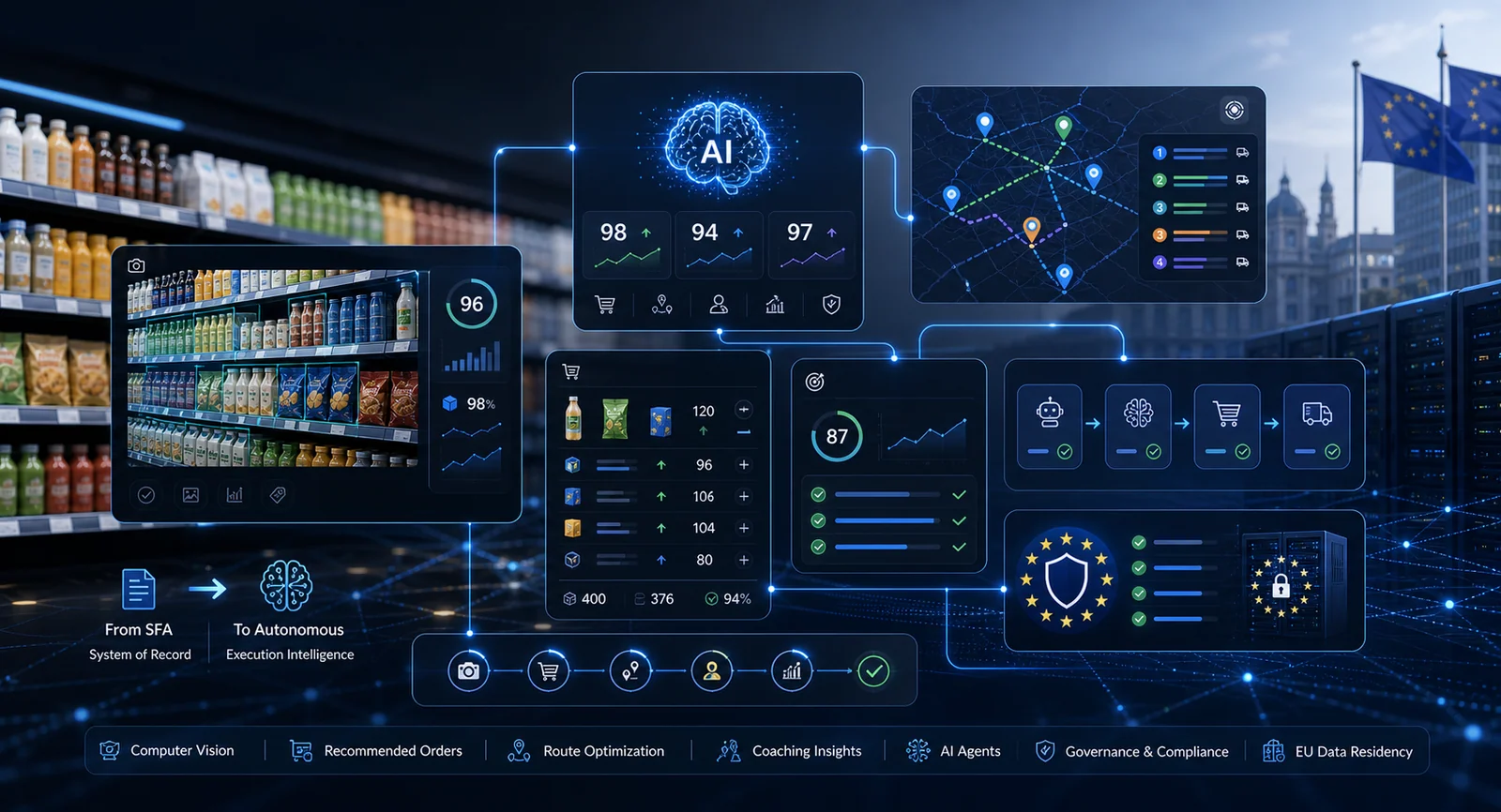
Most FMCG companies do not suffer from a lack of data. They suffer from a lack of timely action.
The field rep has a route. Tasks. Store photos. Order history. GPS. Promotions, must-stock lists, planograms, bonus schemes, targets, overdue payments, missing SKUs, competitor pressure and five other things happening in the same store at the same time.
Classic SFA digitized much of this. That was a major step forward. But after a certain point, the system starts to look more like an archive than an assistant.
It knows where the rep went. It knows what was entered. It knows what was photographed. It knows what was ordered. But it often does not answer the more important question fast enough:
What should be done now?
That is where the difference starts between SFA with an AI module and a genuinely AI-native FMCG platform.
SFA was a system of record. That is no longer enough.
The first wave of field sales software was about control and reporting. Visits had to be visible. Orders had to enter faster. Managers had to know who was in the field and what had been done.
This is still important. Without operational discipline, no AI system will save the process. But reporting alone does not improve shelf execution.
The real store problem is not that somebody filled in a form badly. The problem is that:
- a hero SKU is out of stock;
- a competitor took the better eye-level position;
- a promotion price is missing;
- the rep orders by habit instead of real demand;
- the route covers every outlet, but not in the right priority;
- the manager sees the gap three days later, when it is already too late.
These are execution problems, not reporting problems. If software only documents them but does not close them into action, its value remains limited.
Bain has long treated in-store execution as a major growth lever in consumer products. Its Perfect Sales Execution and Perfect Store work points to the same idea: the right store, the right product, the right placement and disciplined execution can produce measurable growth, including more than 5% sales growth in the first year in well-run programs. This is not magic. It is a process that can finally be measured objectively and managed close to real time.
What changed in 2025-2026
AI did not appear yesterday. Demand forecasting, route optimization and scoring models have existed for years. What changed is that three technologies matured at the same time:
- Computer vision can now read the shelf fast and cheaply enough to become part of the normal store visit.
- Generative and agentic AI can translate complex data into action, not just another dashboard.
- Edge AI and mobile hardware allow some analysis to happen on the phone, in the store, even with weak connectivity.
McKinsey’s State of AI 2025 reports that 88% of organizations use AI in at least one business function. More importantly for this topic, 23% say they are scaling at least one agentic AI system, while another 39% are experimenting with AI agents. The direction is clear, but success is not automatic. Most companies are still somewhere between pilot and transformation.
Gartner is also shifting the language from AI assistants to outcome-focused workflow. In its 2026 predictions, enterprise software will not win simply by adding copilots that advise. It will win by taking delegated responsibility for outcomes inside policy, identity and governance constraints. Gartner also warns about agent sprawl: if every function creates its own agents without control, complexity explodes.
The FMCG lesson is simple: AI should not be another window. AI should be part of execution.
AI-native does not mean “we added a chatbot”
The easiest way to fake an AI strategy is to add a chatbot on top of an old product and call it AI-native.
That is not AI-native. That is an interface.
An AI-native FMCG platform is designed around decision loops. It does not start with “where can we put AI?”. It starts with:
Which field decisions happen every day, depend on data and can be improved by a recommendation, automation or control?
In FMCG these decisions are concrete: store, shelf, order, route, promotion, availability, person.
The five AI loops that change FMCG execution
1. Shelf loop: from photo to action
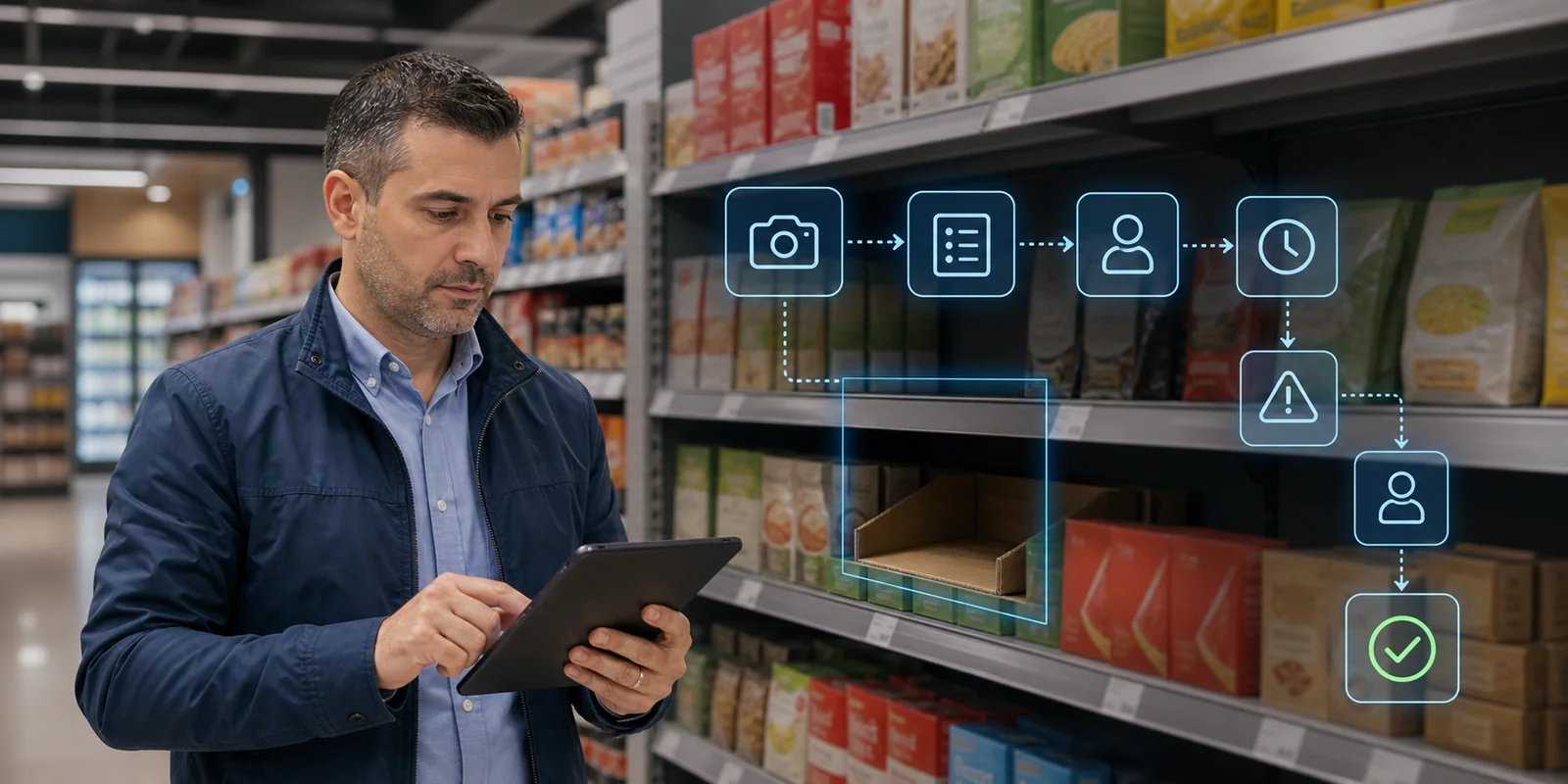
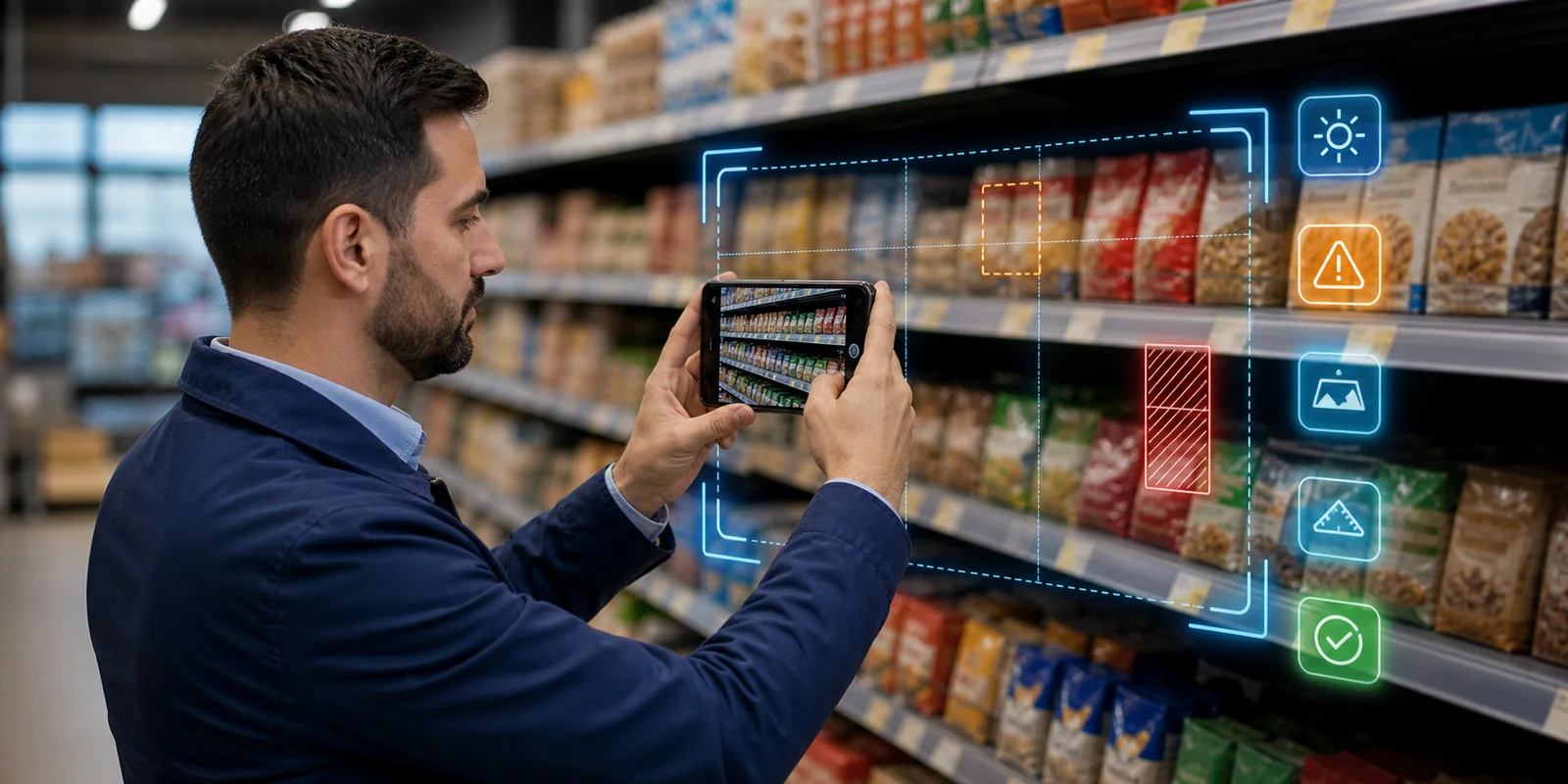
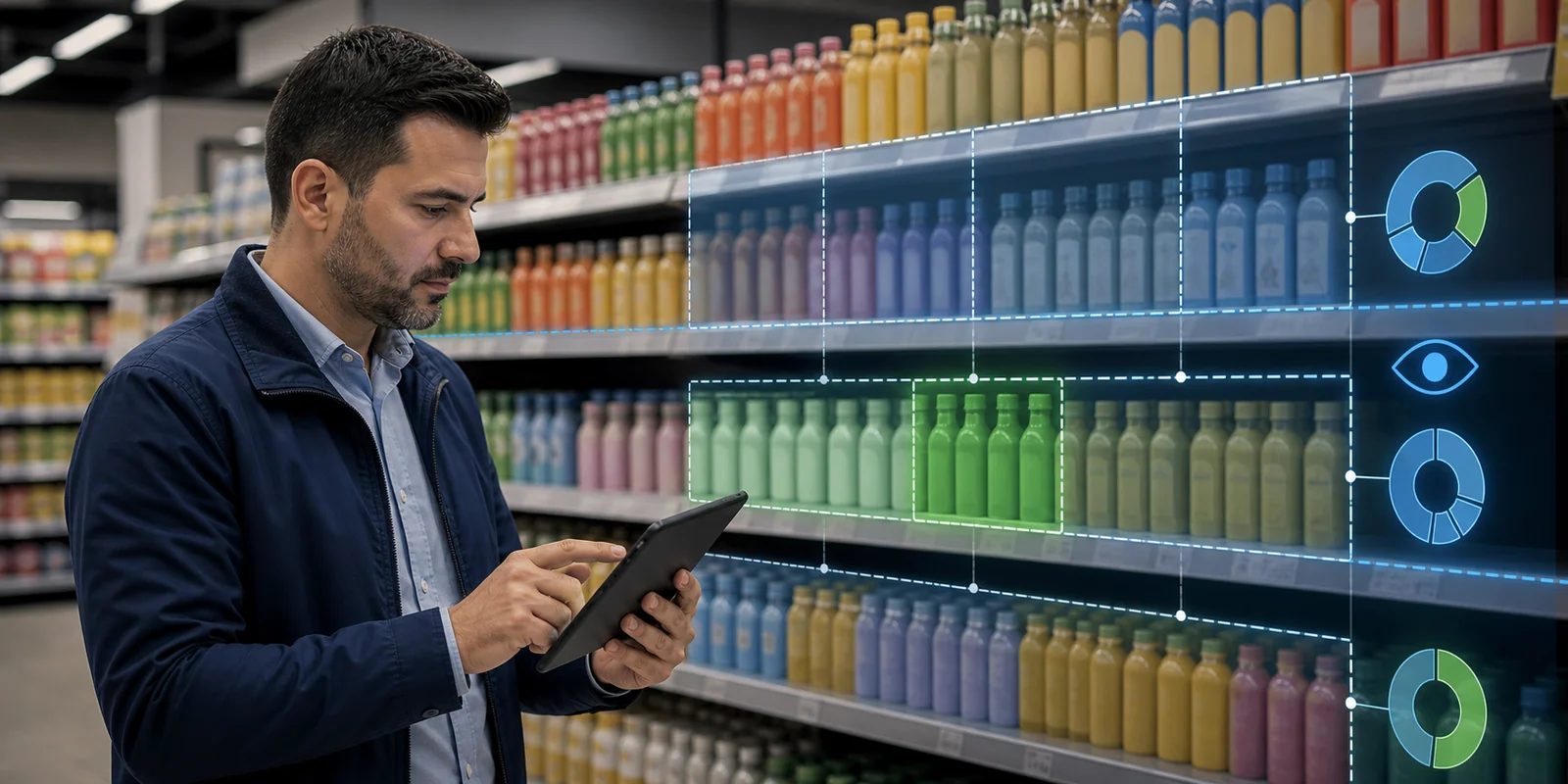
The rep photographs the shelf. Computer vision finds products, recognizes SKUs, counts facings, detects gaps and checks the result against the planogram.
But the value is not a pretty photo with boxes. The value is the next action:
- replenish the missing hero SKU;
- rebuild the brand block;
- check the outdated promo price;
- add the missing must-stock item;
- escalate to a supervisor if the issue repeats.
That is the difference between image recognition as a feature and shelf execution as a business loop.
2. Order loop: from history to recommended quantity
In classic SFA, the order is often a routine. The rep knows the customer, knows the usual pattern, checks past orders and adds “more or less the same”.
But “the same” is dangerous in FMCG. Seasonality, promotions, out-of-stock, store traffic, local competition and remaining stock can make the past pattern wrong.
An AI-native order loop looks at more signals: sell-in, sell-out, visit frequency, shelf gaps, promotion calendars, case constraints, out-of-stock risk, similar outlets and execution scores.
The result is not “AI says 12”. It is a recommendation with a reason: “12, because sell-out is rising, the promotion starts Friday and the last order covers only four days.”
The rep can still override it. But they no longer start from an empty field.
3. Route loop: from geography to priority
Many route optimization projects fail because they treat the route as a logistics problem: minimize kilometers, reorder outlets, reduce travel time.
In FMCG, the route is also a commercial problem.
Not every outlet matters equally today. One has a high out-of-stock risk. Another is in promotion week. A third is strategic for the category. A fourth has low potential and can be visited less often. A fifth has a payment issue.
An AI-native route loop does not only ask “what is the shortest route?”. It asks:
Which visits will change the result this week?
That moves routing from a map to a priority commercial program.
4. Coaching loop: from control to development
The manager often sees the result, but not the behavior that caused it. One rep has low average order value. Another skips promo materials. A third photographs the shelf but does not fix the problem. A fourth has strong customer relationships but weak execution standards.
Classic systems show KPIs. AI-native coaching looks for patterns:
- which task types are missed;
- which channels see weaker execution;
- what happens after a recommendation;
- who needs micro-coaching, not another generic meeting;
- whether the issue is the person, the process or the plan.
This does not mean automated people evaluation without context. A well-designed AI system should help managers ask better questions, not punish mechanically.
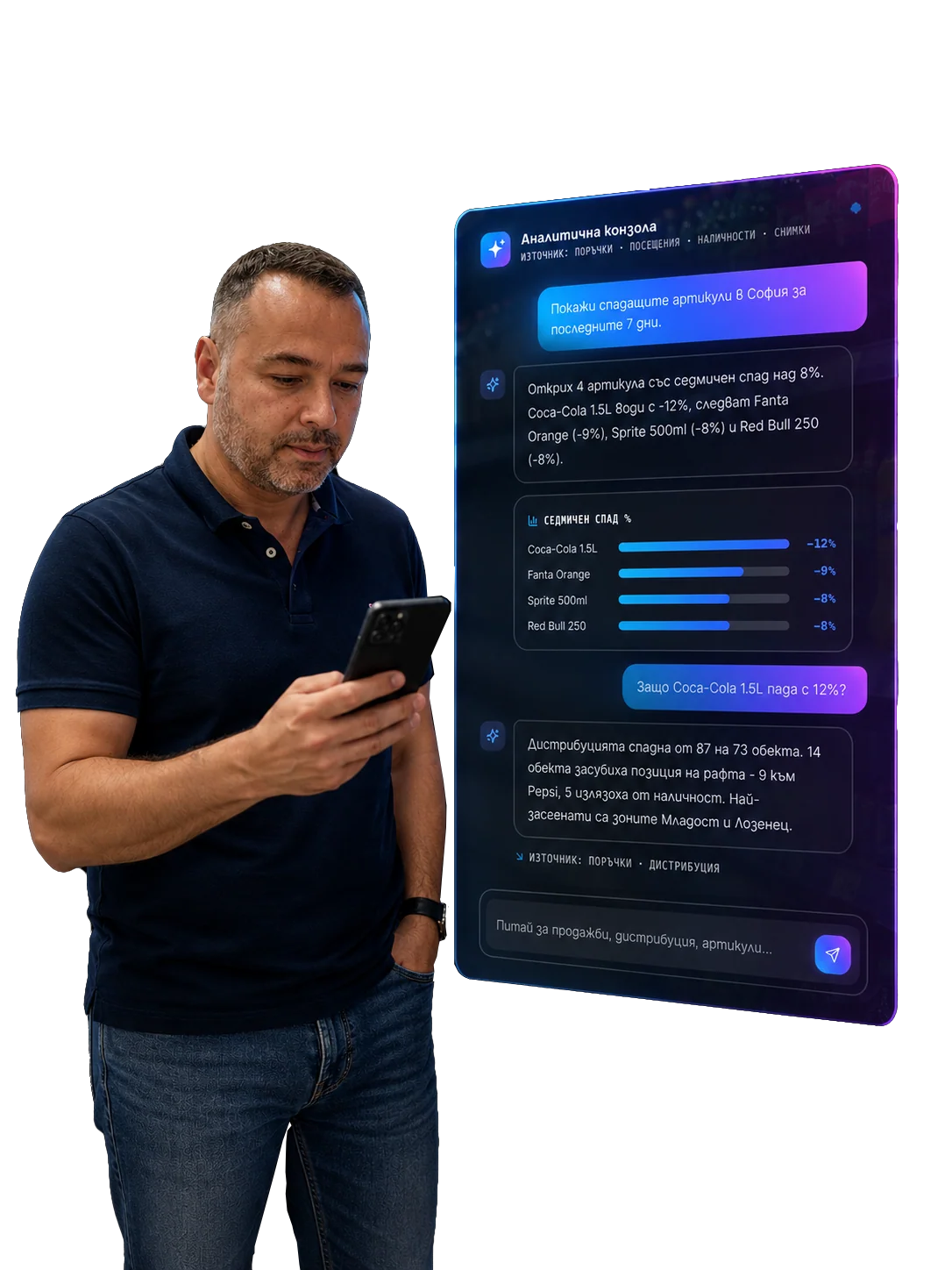
5. Agent loop: from question to completed task
This is where agentic AI becomes practical.
Not a chatbot that knows the documentation. An agent that works inside a business process:
- “Show me outlets with high risk of missing top SKUs before Friday.”
- “Create follow-up tasks only for the key accounts.”
- “Explain why this rep’s execution score dropped.”
- “Prepare next week’s plan for Region North.”
- “Find outlets where the promotion is active but the shelf is not compliant.”
The difference is that the agent does not only answer with text. It reads context, proposes action and, with permission, writes back to the system.
That is powerful. That is also why it must be controlled.
Autonomous does not mean uncontrolled
The word autonomous can sound risky. In business software, it should not mean that AI does whatever it wants.
The right model is controlled autonomy:
- AI can recommend freely;
- it can execute only allowed actions;
- thresholds define what can be approved automatically;
- sensitive actions require a human;
- every decision has an explanation;
- every action has an audit trail;
- rights follow role, region and customer;
- data stays in the right jurisdiction.
This matters especially in Europe. The EU AI Act entered into force on 1 August 2024, and the European Commission describes 2 August 2026 as the general application date, with exceptions for some categories. Most FMCG execution AI tools will not be high-risk by default, but transparency, logging, data governance and human oversight will increasingly become the standard for trust.
That is why “EU-built” is not decorative. For an AI-native FMCG platform it means practical things: EU data residency, GDPR-first processes, logs of AI decisions, explainable recommendations, control over external models and clear boundaries between recommendation and action.
What an AI-native FMCG stack looks like
Strip away the marketing and the architecture should be understandable:
1. Data foundation
Customers, outlets, SKUs, price lists, promotions, order history, stock signals, routes, photos and execution results.
2. Mobile execution layer
The rep does not work in a BI dashboard. They work in a store. Mobile UX must be fast, offline-capable and clear.
3. Intelligence layer
Computer vision, demand forecasting, route scoring, anomaly detection, customer segmentation and execution scoring.
4. Agent layer
AI agents that work with context and tools: creating tasks, explaining deviations, preparing plans and checking compliance.
5. Governance layer
Permissions, audit trails, approvals, model monitoring, data residency and human-in-the-loop controls.
Without the fifth layer, the first four become risk. Without the first four, the fifth is just policy without operating value.
Why many AI projects will not deliver
The biggest mistake is starting from technology.
“Let’s add an agent.”
“Let’s add a chatbot.”
“Let’s build a predictive dashboard.”
“Let’s try computer vision.”
All of these can be useful. But if they are not attached to a daily process, they become demos.
McKinsey’s research shows AI adoption is already widespread, while business impact remains uneven. That matches the field reality: value does not come from the model alone. It comes from the workflow change around it.
In FMCG this means:
- the recommendation must reach the rep while they are still in the store;
- the manager must see the issue before the end of the cycle;
- the task must be created automatically, not in Excel after a meeting;
- AI must read execution context, not only ERP data;
- the result must be measured after the action.
If the loop does not close, AI remains insight. And businesses do not win from insight nobody acts on.
How to start without getting lost
Do not start with “an AI strategy”. Start with three operating questions:
- Which decisions happen every day and are often wrong or late?
- Which data do we already have but fail to use in time?
- Where would one recommendation change action on the same day?
Then choose one loop. Not five.
For example:
- Perfect Store score plus an automatic corrective task;
- recommended order for the top 50 SKUs;
- risk-based routing for key outlets;
- AI coaching for the most common execution gaps;
- a supervisor agent for weekly planning.
Measure it simply: time saved, more outlets covered, fewer shelf gaps, more same-visit task closures, better order accuracy, higher execution score.
Then scale.
The next SFA category will not be SFA
SFA will not disappear. It will become part of a larger category.
The next category will be an execution intelligence platform: a system that collects field signals, understands them, proposes action, controls execution and proves the result.
That is the difference:
- SFA records the visit. AI-native platforms prepare the visit.
- SFA accepts an order. AI-native platforms recommend and explain it.
- SFA stores a photo. AI-native platforms read the shelf.
- SFA shows a route. AI-native platforms prioritize the day.
- SFA reports KPIs. AI-native platforms propose coaching.
- SFA has users. AI-native platforms have people, processes and agents in one controlled workflow.
This is not distant future. This is where enterprise software is moving in 2026: fewer passive dashboards, more workflow, more context and more controlled autonomy.
In short
AI-native FMCG is not a chatbot on top of SFA.
It is a new way to manage execution:
- the shelf is read, not manually described;
- the order is recommended, not guessed;
- the route is prioritized, not merely optimized;
- coaching comes from behavior, not general impressions;
- agents execute tasks inside rules;
- governance is part of the product, not a document after implementation.
Classic SFA answered the question “what happened?”.
An AI-native FMCG platform must answer the harder question:
What do we do now to improve the result in this outlet, this week, with this team?
That is the real shift.
Related in Optimasoft
- Optimasale is the core field execution layer for visits, tasks, orders and field control.
- Image recognition covers the shelf loop: photo, shelf, OSA, facings and planogram gaps.
- AI Order Brain covers the order loop: suggested order, reason and human control.
- Route optimization covers the route loop: priority based on risk, potential and commercial impact.
- AI agents and workflow orchestration are the layers for controlled autonomy and policy-bound execution.
Sources
- McKinsey - The State of AI: Global Survey 2025
- Gartner - Outcome-focused workflow and agentic execution, 2026
- Gartner - Managing AI agent sprawl, 2026
- Bain - Perfect Store and advanced analytics in sales execution
- Bain - Sales execution for consumer goods
- European Commission - AI Act regulatory framework
Related articles